Trenton Art Community Celebrates an Icon in Mel Leipzig




“I have a very bad habit of telling people, ‘I want to do a painting of you,’” said Mel Leipzig to a crowd of supporters at the Trenton City Museum at Ellarslie in 2019. He was talking about a painting he did of his postmaster at her wedding. “She befriended everybody,” he nearly squealed with enthusiasm. The same could be said of Leipzig.
His fans are legion – not only the people he has painted in his 90 years (a recent inventory of his oeuvre numbers over 600) but all the students to whom he taught both painting and art history for decades at Mercer County College’s West Windsor and Trenton campuses.
Flash forward from that 2019 exhibition of Leipzig’s work to summer 2025. Joan Perkes, past president of the board at Ellarslie and art consultant, was hosting a meeting to bring to life her vision for a series of exhibitions titled “Mel at 90.” Leipzig was put on speaker phone – he had just moved into Carnegie Senior Living in Plainsboro. He told the group, excitedly, about befriending another resident by inviting him to be in a painting.
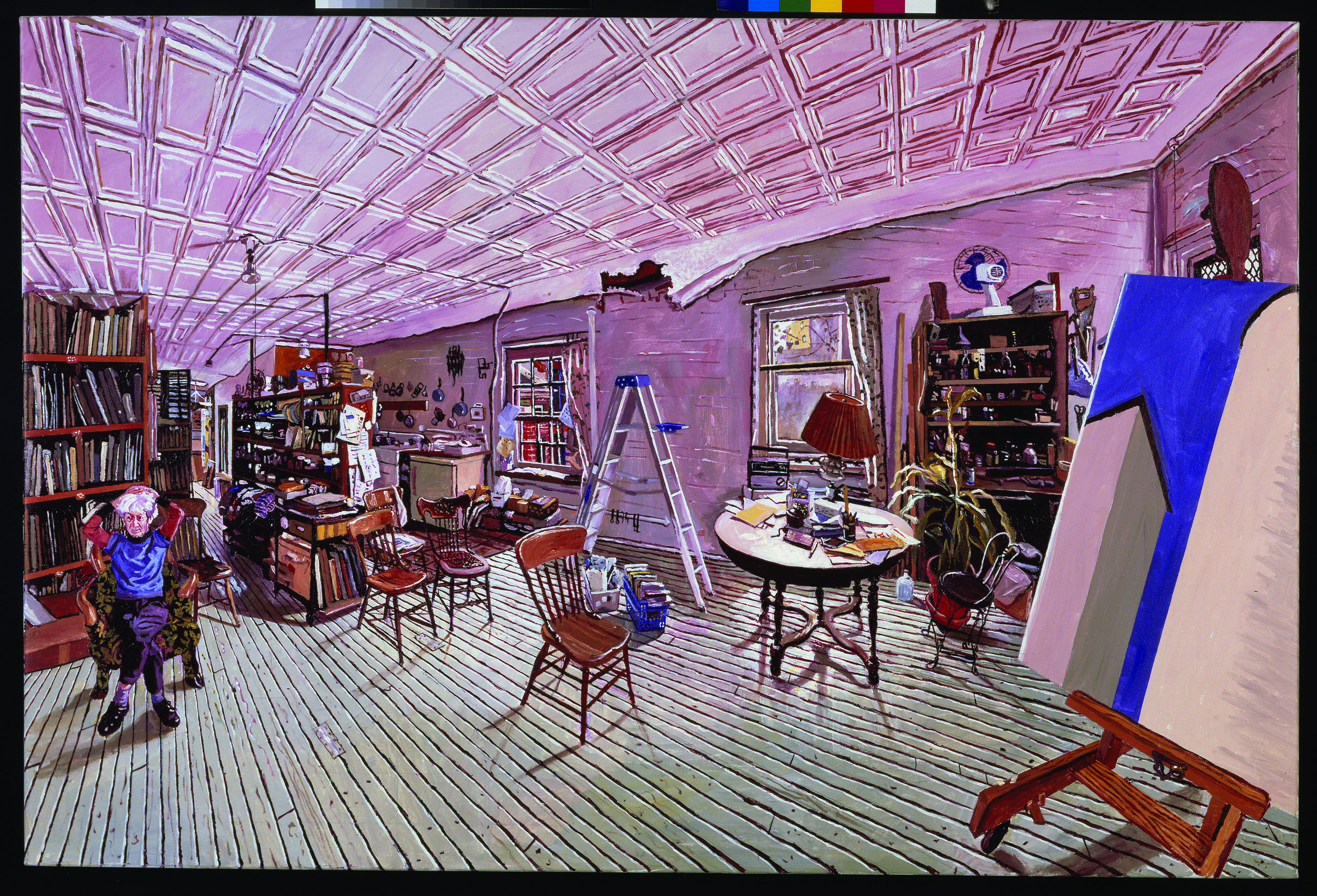
Leipzig had to move out of his Trenton home of many years (a memorable subject in much of his early work) after an accident earlier this year. “It’s almost comical, ‘Artist felled by his paintings,’” Leipzig says of the incident, in which a stack of large canvases fell, pinning him for two days until he was rescued.
A Community Celebrates an Icon: Mel Leipzig at Ninety is a series of five exhibitions in Trenton in the coming months. “The Revival of Realism” will be at the Trenton City Museum at Ellarslie, October 24 to January 4, with an opening reception on October 24, 6-8 PM. Curated by Joan Perkes, it will include classic paintings by Leipzig, as well as his partners in the Realism Revival: Lois Dodd and Neil Welliver, among others.
“Paintings and Politicians” runs November 3-26 at Trenton City Hall and includes paintings of Trenton Mayor Reed Gusciora and U.S. Representative Bonnie Watson Coleman.
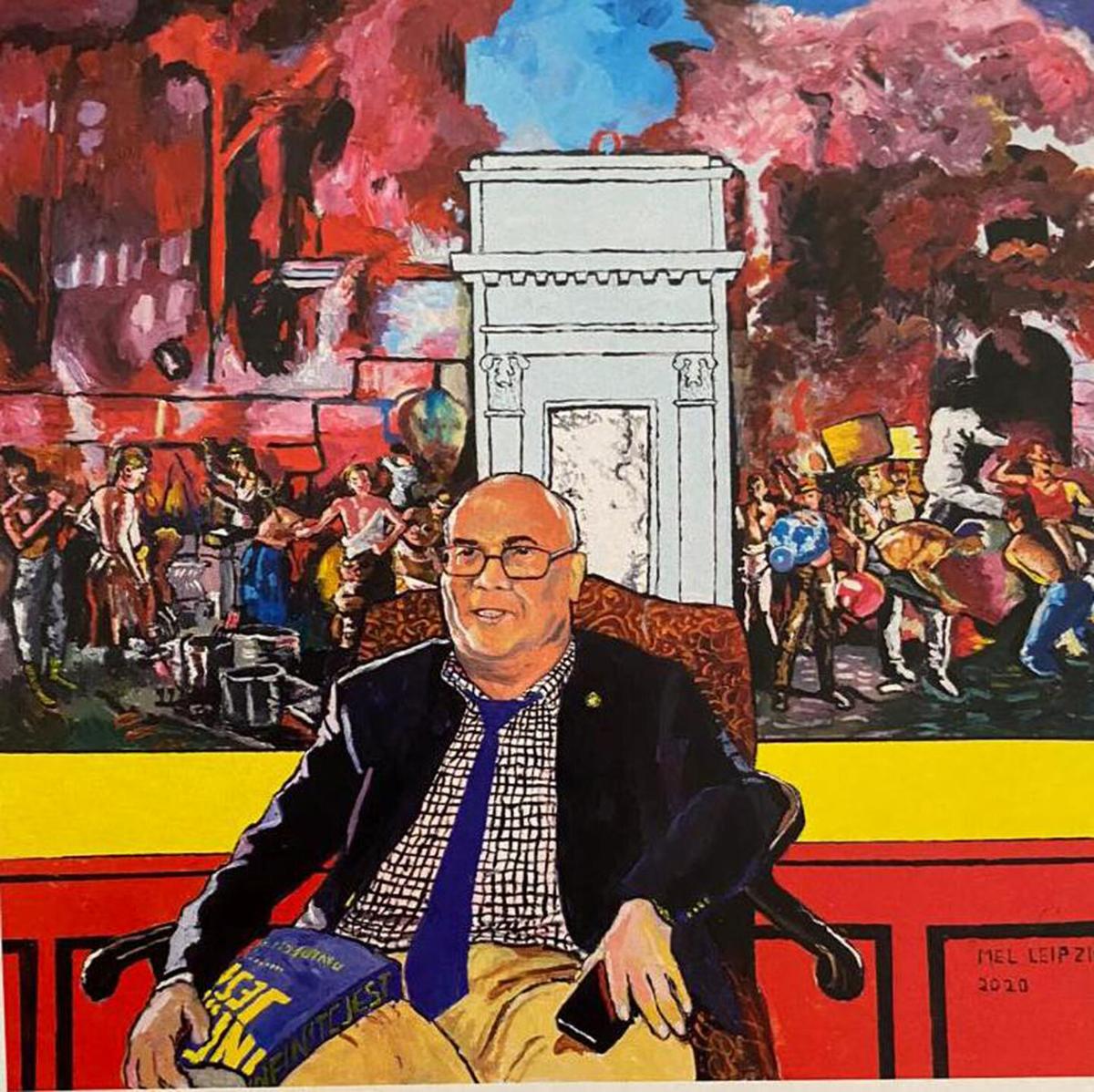
Opening November 7 at the Lobby Club, Trenton, will be “The Architects,” featuring Leipzig’s large canvases – some diptychs and triptychs – of the region’s pre-eminent building designers. It is curated by architects John Clarke and John Hatch.
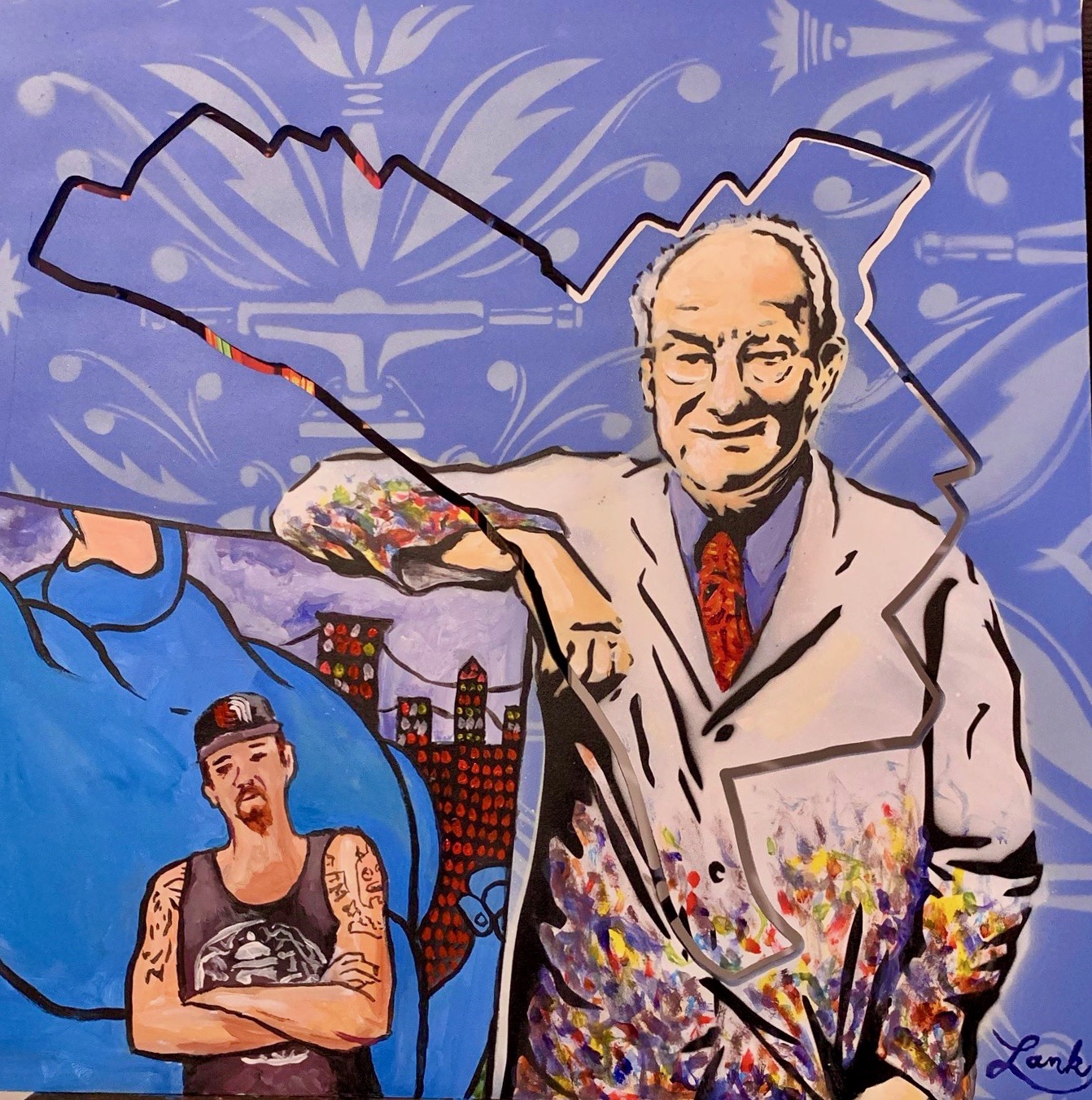
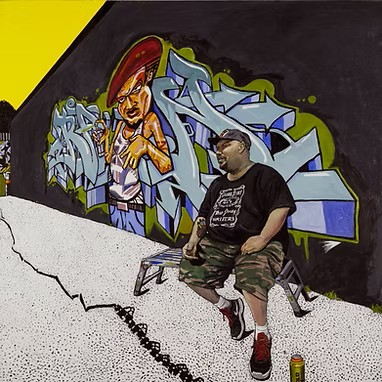
“Tattoo and Street Artists,” curated by Liz Aubrey, will be on view at the Trenton Free Library December 11 to March 21. And “Generation Mel,” featuring artists who at one time studied with Leipzig, will be on view at The Gallery at Mercer County College, West Windsor campus, January 12 through February 27. It is curated by Tricia Fagan and Janis Purcell.
A color catalog with an essay by art critic Dan Bischoff (also painted by Leipzig) is forthcoming.
It is no coincidence that all the curators have been painted by Leipzig. To be painted by Leipzig is to be befriended by Leipzig. “When he paints you, it’s an experience in and of itself,” says Perkes, who has been painted twice. The one with her late daughter — Joanie died from complications of the flu last year — will greet visitors to the Ellarslie exhibition.
“Mel has been a mentor, teacher, catalyst, and keystone in the greater Trenton arts community since his arrival herein 1968,” continues Perkes. “He took the Capital City and turned it into a town, one in which so many came to know and love him. This is a golden opportunity to thank this consequential figure.”
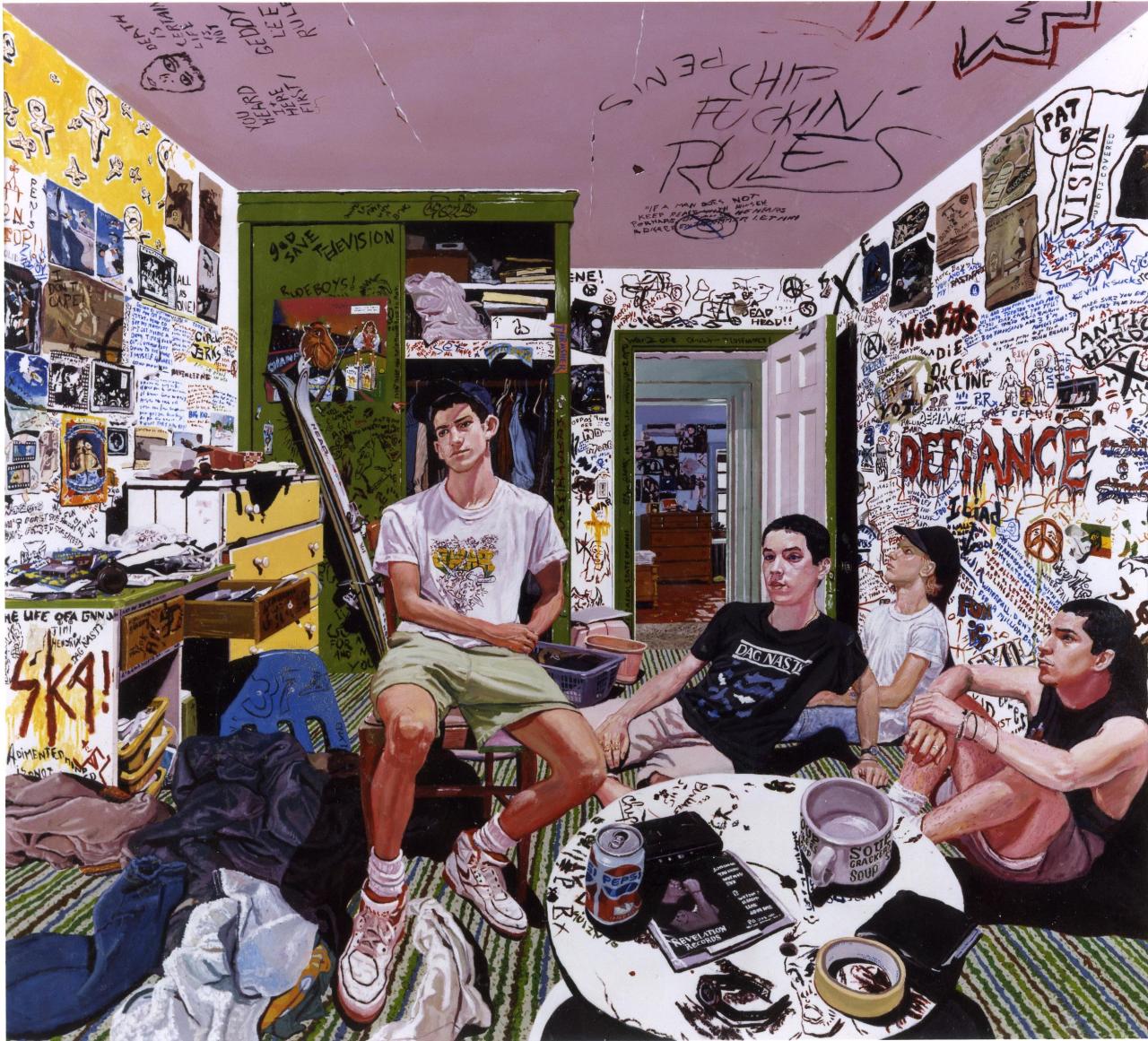
Going through Leipzig’s oeuvre, Perkes was excited to find early examples such as a red interior from 1967 “that informs the work he is doing today. We want to show the journey he’s taken over the years, with an emphasis on the revival of realism he was a part of and where his contribution fits into the art history.” Three of those include portraits of his children, Joshua and Francesca, in their rooms as teenagers, and painter Lois Dodd.
Leipzig’s teenage son stands shirtless in a graffiti-covered room, strewn with his possessions. Leipzig and his late wife, Mary Jo, allowed their children to have full control over their rooms. And by painting it, Leipzig embraced his teenager’s rebellious spirit. This painting and the one of his daughter, Francesca, were the beginning of Leipzig’s environmental paintings – portraits in which the surroundings tell much of the subject’s story. Leipzig finds stories in the chaos of his subjects’ possessions, such as file drawers spilling out their contents. He is like a journalist with a paintbrush. (And yes, he even painted a series of journalists. Full disclosure – I appeared in one.)
“I like the idea of painting scenes of modern life,” he says. “It becomes history.”
Someone in the future, looking to see what middle-class suburban life in America looked like in the late 20th and early 21st centuries, would do well to study the paintings of Mel Leipzig. He has poeticized everything from the texture of dropped asbestos tile ceilings to the graffiti and tattoos people illustrate their lives with. There are teachers, architects and artists; young adults sneaking out by moonlight to experience a world beyond their suburban domicile; parents and their children poised over the remains of dinner, or getting ready to begin the day in the mirrored reflection of a tiled bathroom. He has painted the Capital City’s Italian restaurants, its museums, its curators and grant makers and artists and poets.
“I would only paint a good politician,” he continues. “I would have loved to have painted the Clintons – Hillary came to Ellarslie as part of the conferences of mayors when Bush was president and McGreevy was governor,” he recollects. A photograph Leipzig once kept on his refrigerator shows him with Hillary in front of his painting of former Ellarslie Director Brian Hill, which, apparently, she had voiced admiration for. “She was the most human of politicians, very genuine but forceful,” Leipzig says.
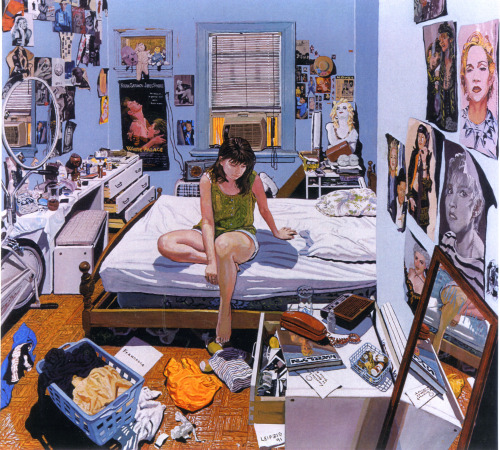
For many years Leipzig refused to work from photographs because it “would dilute the intensity of feeling that I am seeking.” (Nevertheless, he has painted many photographs within his scenes.) He was known for crisscrossing the Northeast in a white van — his studio on wheels — to keep his in situ painting appointments. Wearing a shirt and tie, he’d step into his paint-spattered coveralls and get down to business.
More recently, while he was still living in his Trenton home, Leipzig painted many jazz musicians. Larry Hilton, the late Trenton-based art collector and jazz impresario, brought musicians to Leipzig once he’d become housebound. Leipzig painted Hilton as well.
Leipzig studied at Cooper Union, Yale University (under Josef Albers – Leipzig always felt like a realist in an abstract expressionist world) and Pratt Institute, where he earned his M.F.A. He received a Fulbright Grant to Paris, four grants for painting from the New Jersey Council on the Arts, and a grant from the National Endowment for the Arts (1996). Other awards include a Fulbright Traveling Fellowship and the Louis Comfort Tiffany Award. In 2006, he was elected to the National Academy. Among the many museums and institutions in which his works can be found are the White House Collection in Washington, D.C., the Whitney Museum, the Yale Art Gallery, the National Endowment for the Arts Gallery, the New Jersey State Museum and the Cooper-Hewitt Museum. The Princeton University Art Museum recently acquired his multipaneled painting of ceramic artist Toshiko Takaezu.
“Most people have no idea how difficult it was to be a realist painter in the 1950s,” Leipzig said recently. His easel held a just-completed painting of his former student Alan Bennett. In choosing his current living facility, Leipzig insisted that there be a studio where he could keep up his practice, painting almost every moment of his waking life. The brightly patterned rug in the studio can be seen in the painting of Bennett. There are two other paintings in progress, awaiting the models to return. There’s a mirror from which Leipzig can paint self-portraits.
“Even though I was an art teacher, I often tell my students that going to art school can be dangerous, it can ruin someone who is gifted in a way that is not in line with current trends,” he says. “Artists should follow their intuition, not what teachers push. You have to paint what’s inside you.”
From the curators:
Joan Perkes, curator, art consultant, ‘Mel at Ninety’ organizer
“You see his work, and then one day you understand it: you see the inventions in what he was doing. ” Perkes said she was called to do this during a dark moment in her life. “It was like a ray of light when he said he trusted me implicitly, and it’s been a great deal of fun. It took a whole team of very capable people to execute, and I learned so much talking with the people who love him.”
Dan Aubrey, writer, poet, arts instigator, curator of ‘Paintings and Politicians’
“I have known Mel for 47 years — we became friends working on the Eyes on Trenton Festival. We were brought together by an active personal belief that art was important to a community and to individuals.
“What I love about Mel is that he is able to see beyond his own accomplishments and way of painting in order to help other artists working in a different approach to strengthen their own visions and talents. Additionally, despite his academic training, vast knowledge, and abilities, he remains humble and honestly interested in the lives of various types of people. His models include cafeteria workers, gas station attendants, clergy members, political leaders, graffiti artists, friends and family, artists, and — everyone!”
Liz Aubrey, artist, former student of Leipzig, curator of ‘Tattoo & Street Artists’
“It wasn't until I returned from college and connected with Mel again through my relationship with Dan” that she really got to know Leizig. “Mel, (his late wife Mary Jo), Dan, and I would go out to dinner with other artists and discuss art, go on field trips, and visit galleries. Mel's knowledge of art is amazing and contagious. I owe a lot to him for inspiring me to continue my pursuits in the art world.”
John D.S. Hatch, architect, curator, ‘The Architects’
“Mel Leipzig is, of course, an icon in the art circles of Trenton, across the state, and even nationally and internationally. Even with his renown, he’s mainly just a wonderful person, endlessly curious about people and the spaces they inhabit. His paintings vividly document this connection between his subjects and their environments, so it makes complete sense that some of his subjects are architects, whether regionally or internationally well-known.”
Tricia Fagan, arts & history program administrator, grant writer, curator, ‘Generation Mel’
“As a professor, Mel had a rare capacity to identify and nurture what made each of his students' works unique, passing along to hundreds of artists both the skills and the belief in their own work needed to live the artist’s life. In some real ways, having a conversation with Mel is an art lesson, so aren't we all students of Mel's?”


