ArtYard Celebrates a Decade Presenting Bold Work in a Creative Home





Full disclosure: I get a lot of ads for the perfect bra. One that doesn’t dig in, one that doesn’t bind, that doesn’t cut off circulation or make you want to run home and rip it off. The advertisers claim to have the one and only that is so comfortable you’ll fall asleep in it. Each brand claims that all other bras are torture devices – worst of all, say the ads, is bras that result in the dreaded uniboob.
One of ArtYard’s summer exhibitions, Mom Bras, seems like the perfect antidote to those ads: Here are handknit bras made from soft wool that, in the words of artist Cassie Arnold, “are an invitation to discuss the complexities of a life with breasts.” From teenage mosquito bites covered with training bras to voluptuous womanly orbs tantalizing in lace, breasts – if they are lucky — go on to become utilitarian feeding machines.
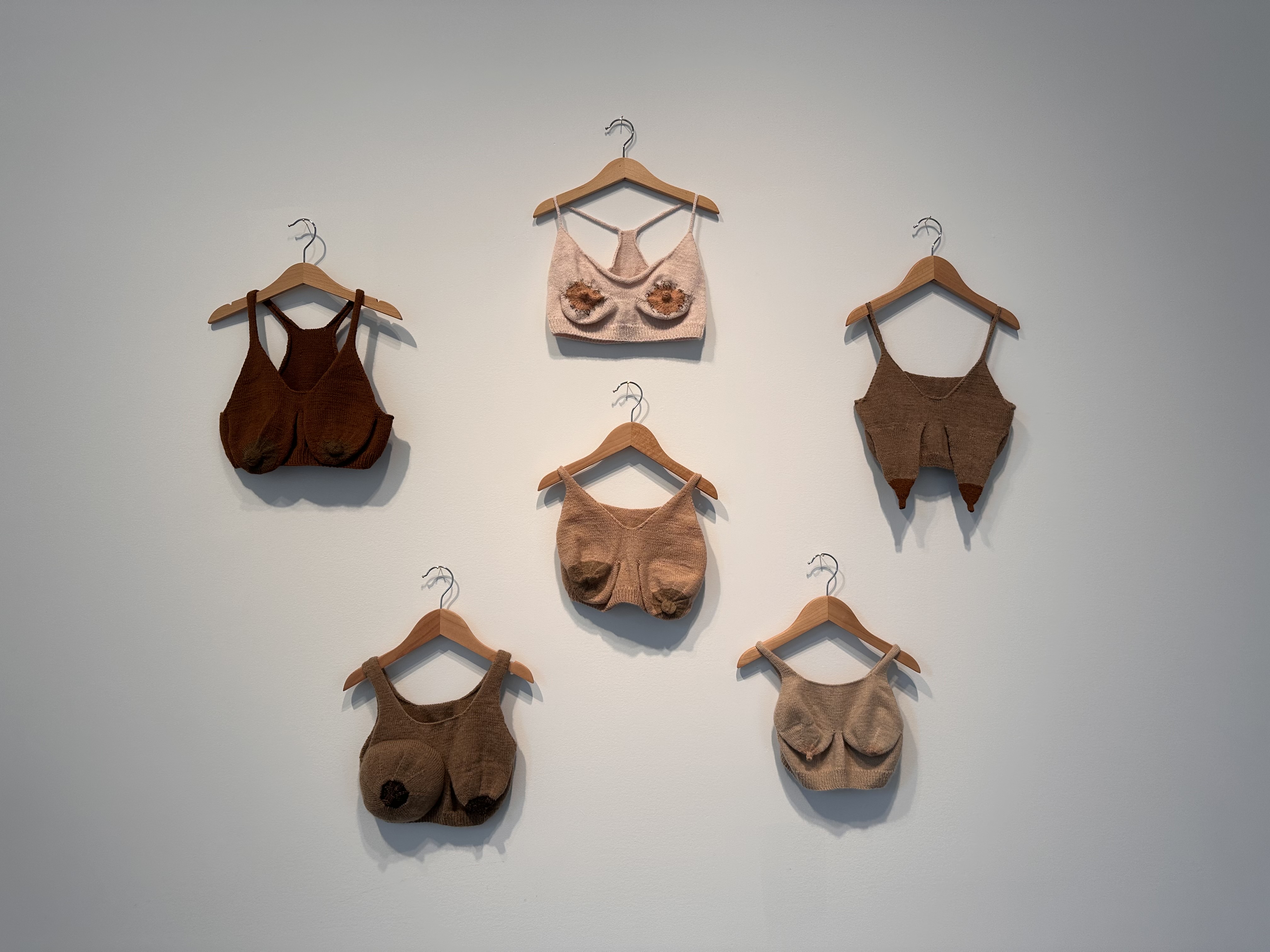
Mom Bras reminds us that breasts come in all shapes and sizes. Here we see bras made for drooping breasts, lactating breasts that have been sucked into cow-like teats; a bra in a cowhide print, emphasizing the milking machine concept; a bra for just one breast. One, titled “Perimenopause,” is “for the tired, anxious, and irritable.” Another, with black wiry threads sprouting around the areola, is dedicated to rogue black chin hair that secretly pops up in middle age.
“The Mom Bra series stands today as a rejection of the unrealistic portrayal of the female form,” writes Arnold. “Decades of perfectly airbrushed and digitally altered photos in the media have set unrealistic and unattainable body standards. This work, in comparison, is a form of gentle protest against those expectations. Mom Bras celebrate the natural curves, scars, wrinkles, hairs, and textures of our breasts and help us tell the story of who we collectively are as women.
“Maybe you will see your exhausted sister or your grandmother’s scars,” continues Arnold. “Maybe you will see yourself and feel connected and proud. Maybe this series will allow you to see bodies that are different from your own.”
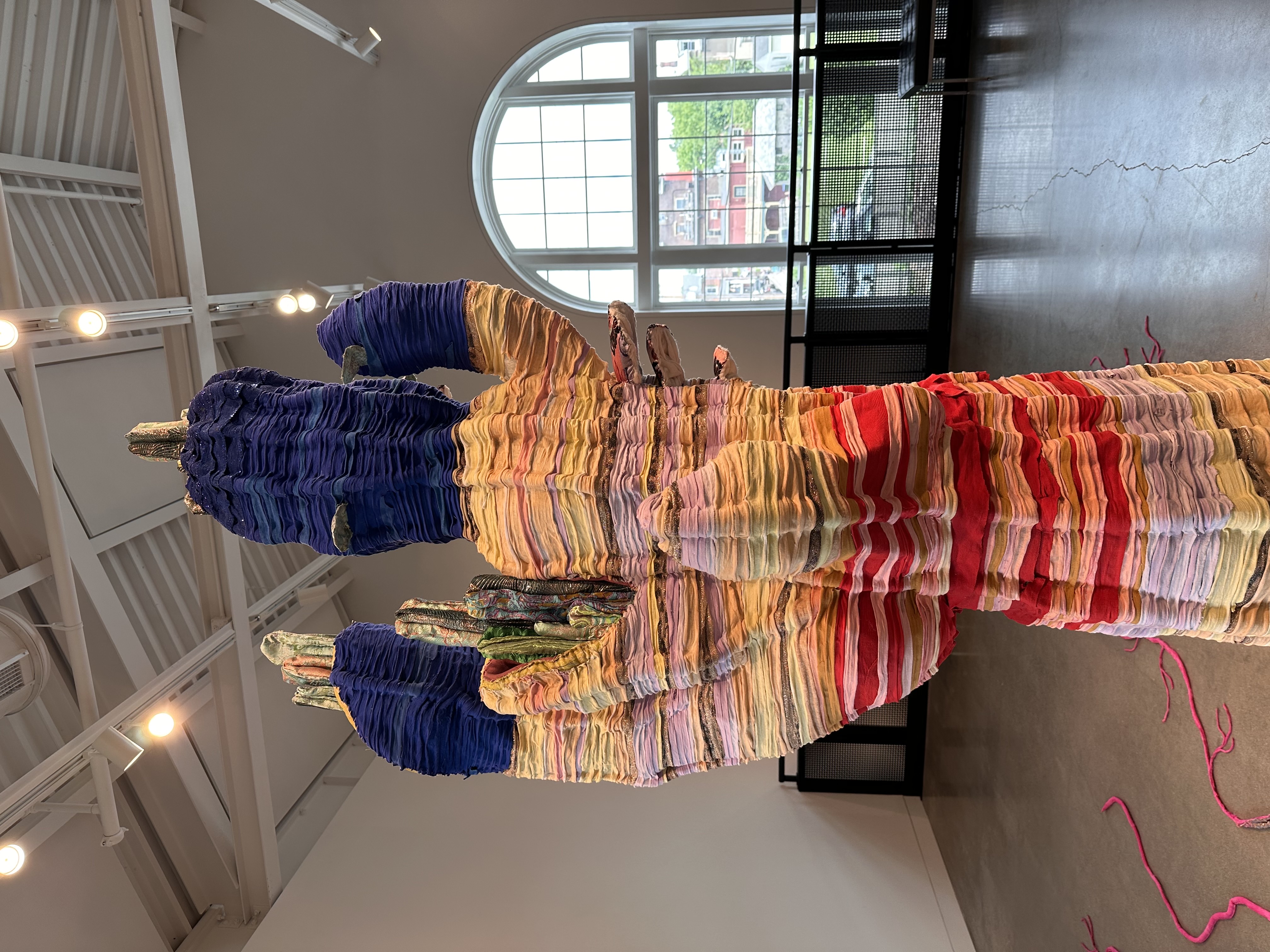
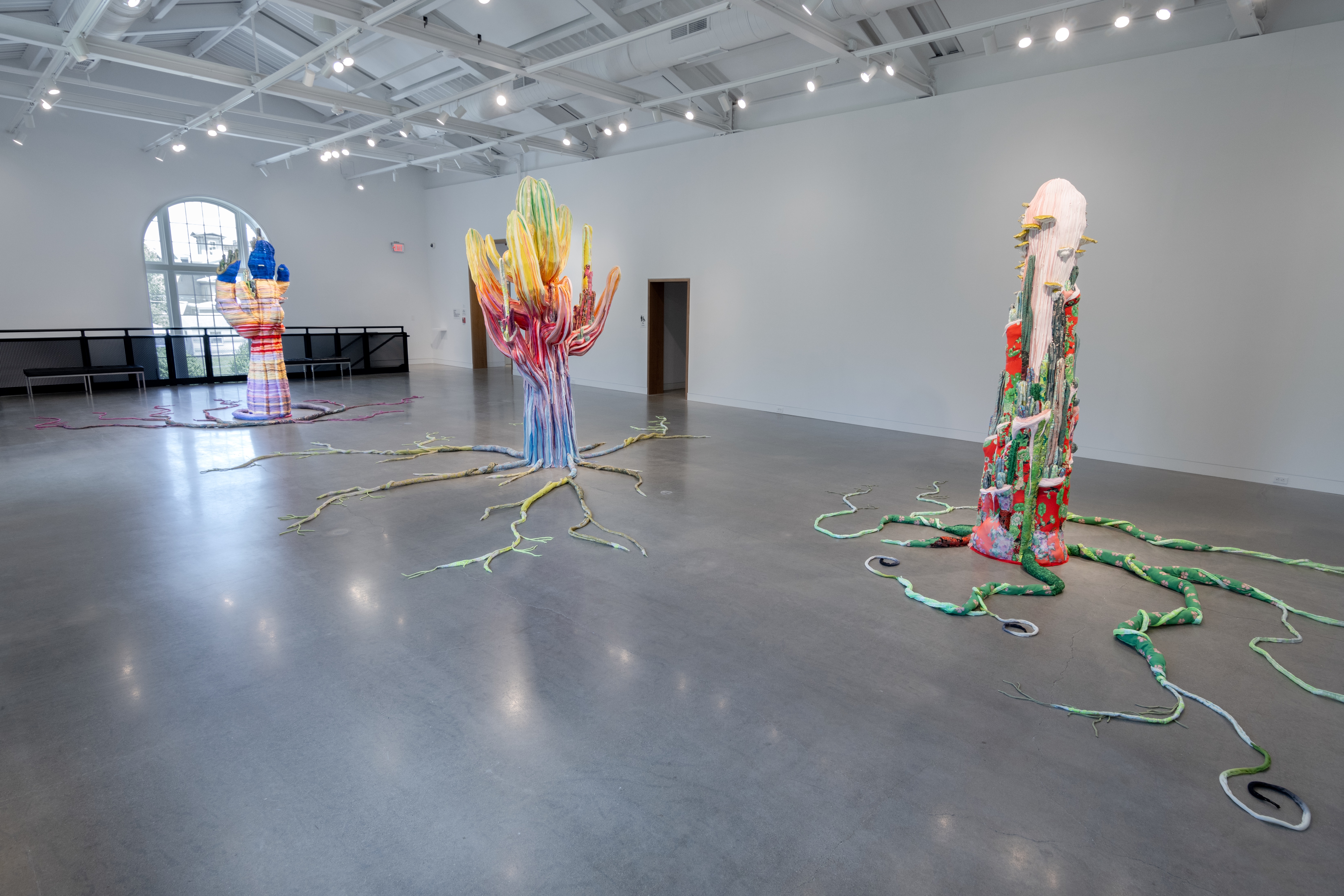
In the larger gallery on the second floor are large, colorful cacti. Look up close, and you’ll see these cardons, sometimes called elephant cactus and native to Mexico, are made of fiber. Discarded clothing, in fact, in brilliant colors and patterns. The cacti in Phantom Limbs have roots spreading out on the bare floor. Cardon cacti have a symbiotic relationship with bacterial and fungal colonies, allowing them to grow on bare rock, even where no soil is available.
They sprout fruit, mushrooms, and little colonies of baby cardons. The mushrooms signal both decomposition and resilience. Raised in Argentina, artist Tamara Kostianovsky first became smitten with desert plants at the Brooklyn Botanical Garden.
Behind the towering cacti are meat carcasses, also made of discarded clothing. The twisted cable of what was once a fisherman sweater forms a rim at the opening, and a beautiful bird is exploring the inside.
Kostianovsky uses meat, human flesh, animals, and the landscape to explore the raw elements of life and regeneration. Layers of fabric suggest muscle, cells, tissue. Kostianovsky’s practice originates from an early experience assisting in a surgeon’s office where she encountered a landscape of veins, ligaments, and fat activated by vivid color and dense texture.
“I have always viewed the slaughtered carcasses that I make as female in the sense that they are self-portraits, made with articles of female clothing, unsentimentally cannibalized from my own closet.”
There have been numerous encounters with blood and gore in the Brooklyn-based artist’s life. When she and her brother were walking to school one day, they passed an open truck into which a man was loading an enormous side of a beef carcass. “The red and pink layers of flesh contrasting against the sleek surface of the vehicle mesmerized me,” she writes in the exhibition catalog. “I had peeked into a world where children weren’t allowed and I had seen the forbidden.”
One fateful day, when her 81-year-old Jewish grandmother was making tomato sauce for stuffed cabbage, a family favorite, she was found in a pool of blood after an intruder entered the apartment. “My uncle later noted that his mother had been slaughtered like an animal,” Kostianovsky writes.
After making a sculpture of butchered cattle, Kostianovsky wanted to experiment with another species and looked online for bird feathers she could replicate in fabric. After placing the order, she was surprised to receive a 10-pound box with a large, dead pheasant. Describing her reaction as “smitten” – “I was in the presence of something simultaneously horrifying and beautiful” – she, her husband, and her son ate the bird for dinner. On a wall of the gallery, hanging from a meat hook, is a beautifully plumed pheasant made from discarded upholstery fabric.
When Kostianovsky’s grandparents left Odessa during the pogroms for Argentina, they brought with them a samovar. When her father died, his possessions included the samovar, a grandfather clock, a collection of classical vinyl and CDs, furniture, and a jungle of house plants he had cultivated. All that Kostianovsky was able to take back to New York were a few suitcases filled with her father’s clothes. “Just as I has been using my clothes to make art about violated women, I could use his to make art about loss,” she writes. She created “bloodless carcasses of trees” as a memorial to her father’s life. “I never washed the clothes. They still contain his cells.”
Kostianovsky first started using discarded clothing because she couldn’t afford art supplies. After teaching in Argentina in the late 1990s, Kostianovsky came to the U.S. to study at the Pennsylvania Academy of the Fine Arts in Philadelphia. Without a lot of resources, she first made art using her dark frizzy hair. Having grown up in a country where people hung their laundry to dry, her first encounter with electric dryers resulted in shrunken garments -- a new art material was born! “I was finding a way to include my own body in the work as a second skin.”
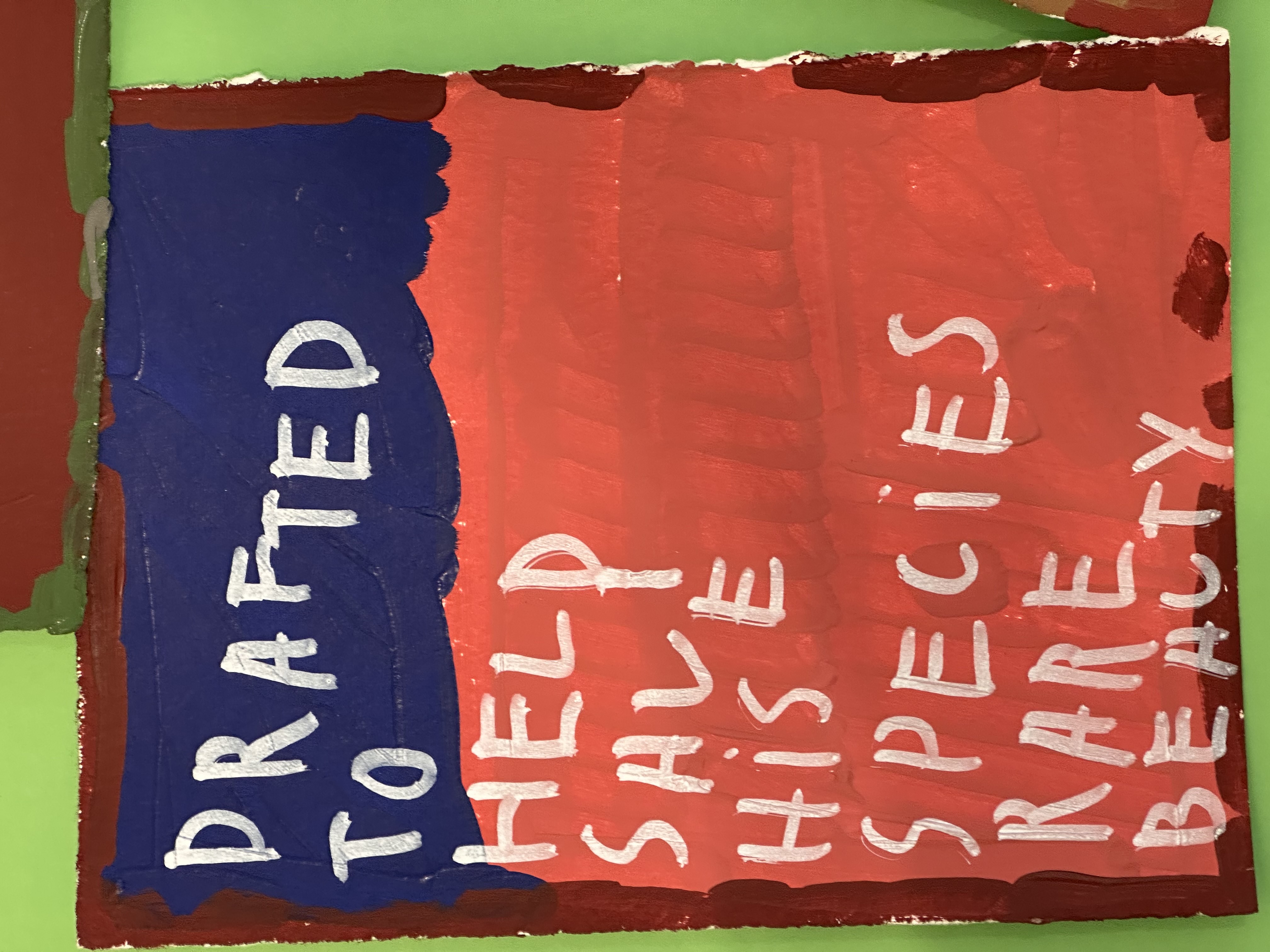
In the gallery devoted to ArtYard's sibling organization Studio Route 29 -- a supported art studio for people with intellectual and developmental disabilities -- is Vanishing Point Forever, a small but powerful exhibition by artist Michael Angelo Mangino. The Pittstown resident has had solo shows in New York and Philadelphia, and shown at Art Basel Switzerland. Against colorfield backgrounds are profound words, be they poems, koans, or random arrangements of thoughts that come together in meaningful ways. Studio Route 29 Executive Director Kathleen Henderson says Mangino may start with word search books or text from magazines, such as National Geographic. Mangino, who Henderson describes as mostly nonverbal, arrives at the studio, puts his lunch in the refrigerator, gets out his supplies, and goes to work. “He loves text; he loves reading and writing and the joy of brushstroke.”
Also on view is David Bailin: A Divine Comedy, large-scale drawings made with charcoal and coffee, on milk carton overstock “of humans mired in sinkholes of their own making. Bailin works and reworks his drawings, erasing and drawing over the same surface, sometimes over a period of years,” writes ArtYard Founder and Executive Director Jill Kearney, who curated this as well as Mom Bras and Phantom Limbs.
In “Hedge,” for example, we see a lineup of silhouetted figures against a stark landscape, holding out capes or cloaks, indeed forming a hedge. In “Pond,” we see two silhouetted figures engaging behind a tall stand of cattails in the water – it’s not at all clear what’s going on. “For years the characters inhabiting my drawings persevered no matter how absurd that perseverance was… The drawings focused on that figure as he (it was always he) did battle with some crisis of minutiae or conundrum,” writes the artist.
“Landscape and weather systems feature prominently in these quiet, troubling, resolute masterworks,” continues Kearney. “There is a seductive beauty to his tableaux of yearning, hubris, and self-delusion rendered with loving attention to light and line.”


