State Museum Showcases New Jersey’s Finest Artists in 'Recent Acquisitions'




The New Jersey State Museum, in the state’s capital city, is an underappreciated jewel. With free admission and generous viewing hours (Tuesday - Sunday, 9 a.m. to 4:45 p.m.), it’s a chance to see the work of some of the finest artists without schlepping to New York.
“Recent Acquisitions: Fine Art” includes works by artists Robert Smithson, Cindy Sherman, Willie Cole, Melvin Edwards, Nancy Cohen, John Goodyear, Joseph Stella, and Purvis Young, among others.
“Each of these newly accessioned works either addresses a gap or bolsters a strength in the museum’s contemporary holdings,” says Fine Arts Curator Sarah B. Vogelman, who joined the museum in 2022. Many have been donated by collectors, including a former museum curator.
Since 1964 when it was first established, the museum’s fine arts department’s collection has grown to more than 12,000 artworks that fit the museum’s mission of “broadening exploration of new narratives in American art history,” while highlighting New Jersey’s role in the context of a global art world.
“We take every inquiry seriously,” says Vogelman, “following up with email and viewing images. We do due diligence to research the provenance and gather information to see if it fits the collection mission, filling in gaps or telling the story of American and New Jersey art history.”
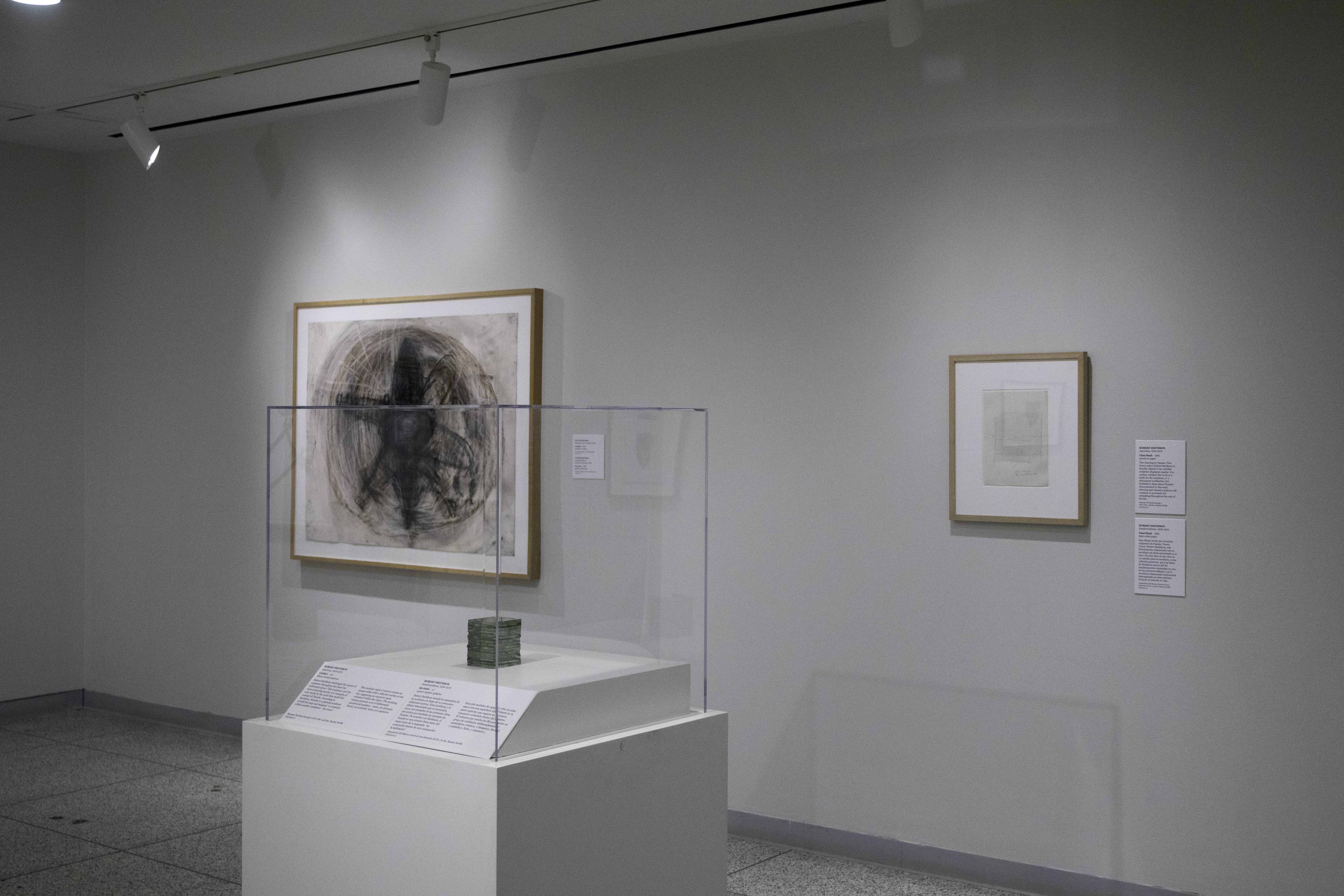
One of Vogelman’s first acquisitions was a small stack of mirrors, roughly three inches square and presented within a glass vitrine, by Robert Smithson (1938-1973). The Passaic native is known for his “non-sites” – he considered these maps, or “landmarkers” constructed from natural materials he chose from remote, unpopulated areas, or the ruins of collapsed buildings. The materials could be brought into the gallery, placed in constructed bins with maps or situated within mirror formations.
"I began in a very primitive way… taking trips in 1965; certain sites would appeal to me more -- sites that had been in some way disrupted...pulverized,” Smithson wrote. “I was really looking for a denaturalization rather than built up scenic beauty.”
Smithson, a founder of the art form known as Earthworks, or Land Art, is perhaps best known for his “Spiral Jetty,” the 1,500-feet long and 15-feet wide coil made of mud, salt crystals, rock and water, that winds counterclockwise off the shore into the water at Great Salt Lake, Utah. Constructed in 1970, it is considered one of the key works of the 20th century. No surprise then that Vogelman was excited to add Smithson’s work to the collection.
In contrast to the size and monochromatic nature of Smithson’s work is an enormous work splashed with yellow and red by Purvis Young (1942-2010). It is the largest and most colorful work in the show. A self-taught artist, Young was known for making collages and composite structures from found objects.
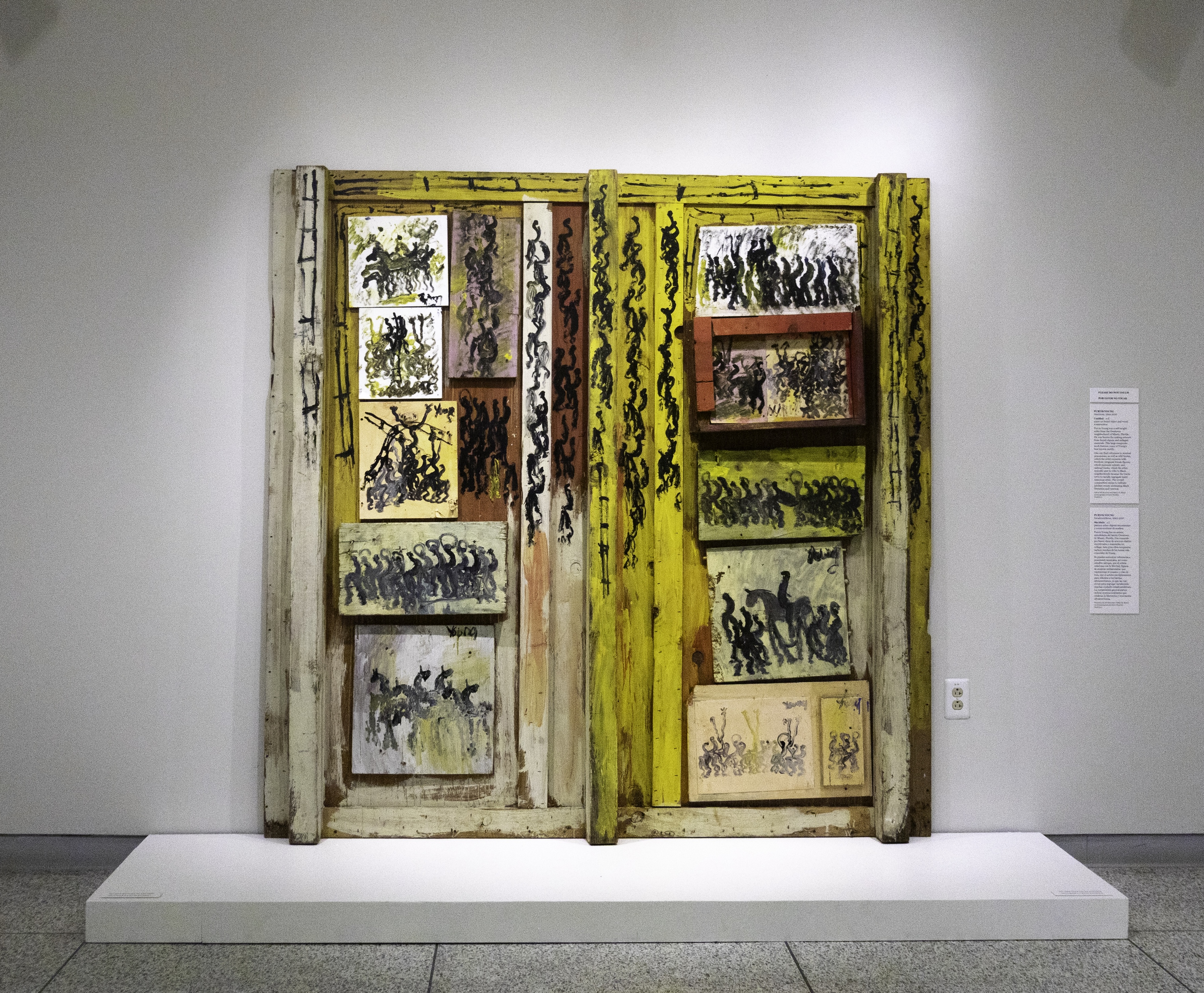
“You can see some of his motifs,” says Vogelman, “such as the railroad tracks that separated black and white neighborhoods.” She points out “processions of wild horses representing freedom and liberation, and pregnant women representing rebirth and Back beauty. The overall composition seems to indicate jubilant events celebrating Black liberation and renewal.”
Of Bahamian descent, “Young paints on scrap lumber and plywood that he scavenges from the streets and vacant lots of Overtown, the historically black neighborhood where he lives in Miami, Florida, and whose long deterioration he has witnessed,” says the Smithsonian Institute website. “He sometimes depicts his surroundings literally, but he paints what he sees with his ‘inner eyes’—and transcends the misery that surrounds him… When he began painting, he was inspired by the popular mural movement of the 1960s. He hung his paintings of tenement life and animals on the exterior walls of abandoned buildings in his neighborhood.”
Young’s work is in the collections of Brice Marden, Jane Fonda, Damon Wayans, Jon Belushi, Dan Aykroyd, and others. The museum was given this work by Jill Bonovitz and Nancy H. Blood in recognition of Janet Fleisher, collectors of Outsider Art who have donated to museums across the country. “They aim to provide images to audiences that may not typically see themselves depicted in fine art,” states the Orlando Museum of Art website. “Young’s work is often positive and is meant to inspire the viewer with a vision of a better world.”
Also offering a vision of a better world is a work on the opposite wall by Robert Duran. This painting was a gift from the Robert Duran estate on the occasion of a major exhibition of the artist’s work at the State Museum last year. With support from the Karma Gallery, as well as the State Museum Foundation, the museum produced an extensive catalog.
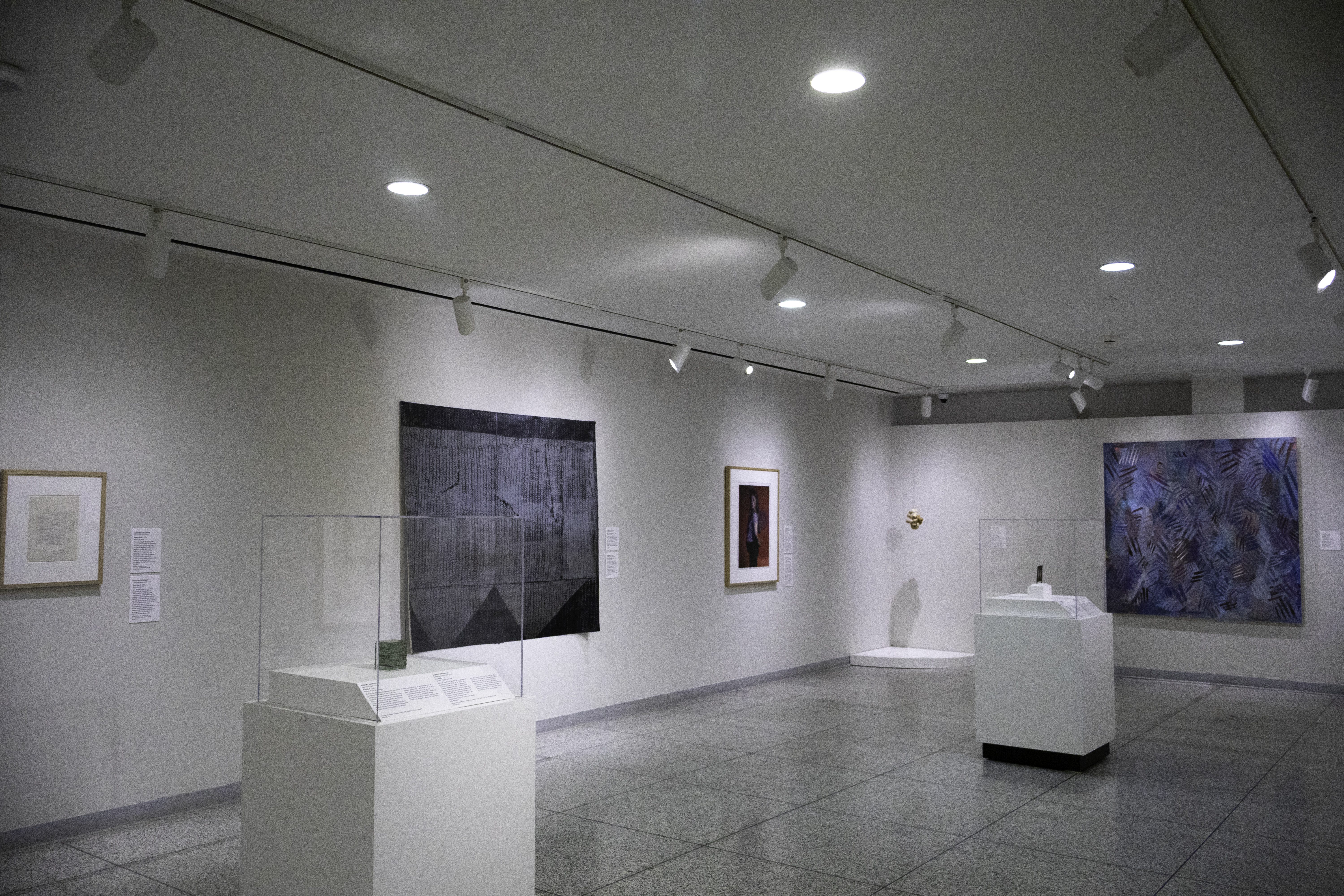
Duran (1938-2005) was born in California to a Filipino father and Shawnee mother. After art school in San Francisco he moved to New York and made sculpture before turning to painting. And yet, with critical success in New York, he moved to Hillsdale, N.J., with his family, no longer interested in marketing his work, Vogelman said. “He took odd jobs: he drove a school bus, did construction and set design,” all while producing a prodigious body of abstract painting.
Another acquisition from a recently exhibited artist is a work by Caroline Burton. Burton collects crocheted and knit blankets and shawls and prints from them on large canvases, using the weight of her body as a press.
“It is with great reverence for the original maker that Burton makes use of these discarded afghans in her work,” Vogelman wrote in the catalog to that exhibition. “She reflects on who they might have been, the hours of labor involved, and the original intended purpose of the objects. Was it a gift? A bit of handmade charm to brighten the home? In fact, Burton sees these unknown makers as silent collaborators.”
Burton’s work on view here took inspiration from the museum’s architecture and she donated it to the museum because she thought it appropriate that it stay in the building, says Vogelman.
The hallway just outside the gallery is hung with many charming works that are smaller in size. Because this isn’t New York City, there is no crowd of people blocking you from getting up close to the artwork, and it therefore takes up as much of your field of view as would, for example, a large canvas by Anselm Kiefer or El Anatsui. Among these smaller works is one untitled ink on paper by Joseph Stella.
Stella was an Italian-born American Futurist painter best known for his depictions of industrial America, especially his images of the Brooklyn Bridge and of Coney Island. Associated with the American Precisionist movement of the 1910s–1940s, he studied art with William Merritt Chase at the New York School of Art and Shinnecock Summer School of Art. Stella returned to Italy in 1909, beginning a lifetime of travel back and forth from his native country, as well as frequent visits to Paris where he would absorb the influences of Fauvism, Cubism and Futurism, according to the Brandywine River Museum where he had a major exhibition in 2023. He also traveled to North Africa and Barbados but would return to New York, where he was viewed as a ground-breaking modernist.
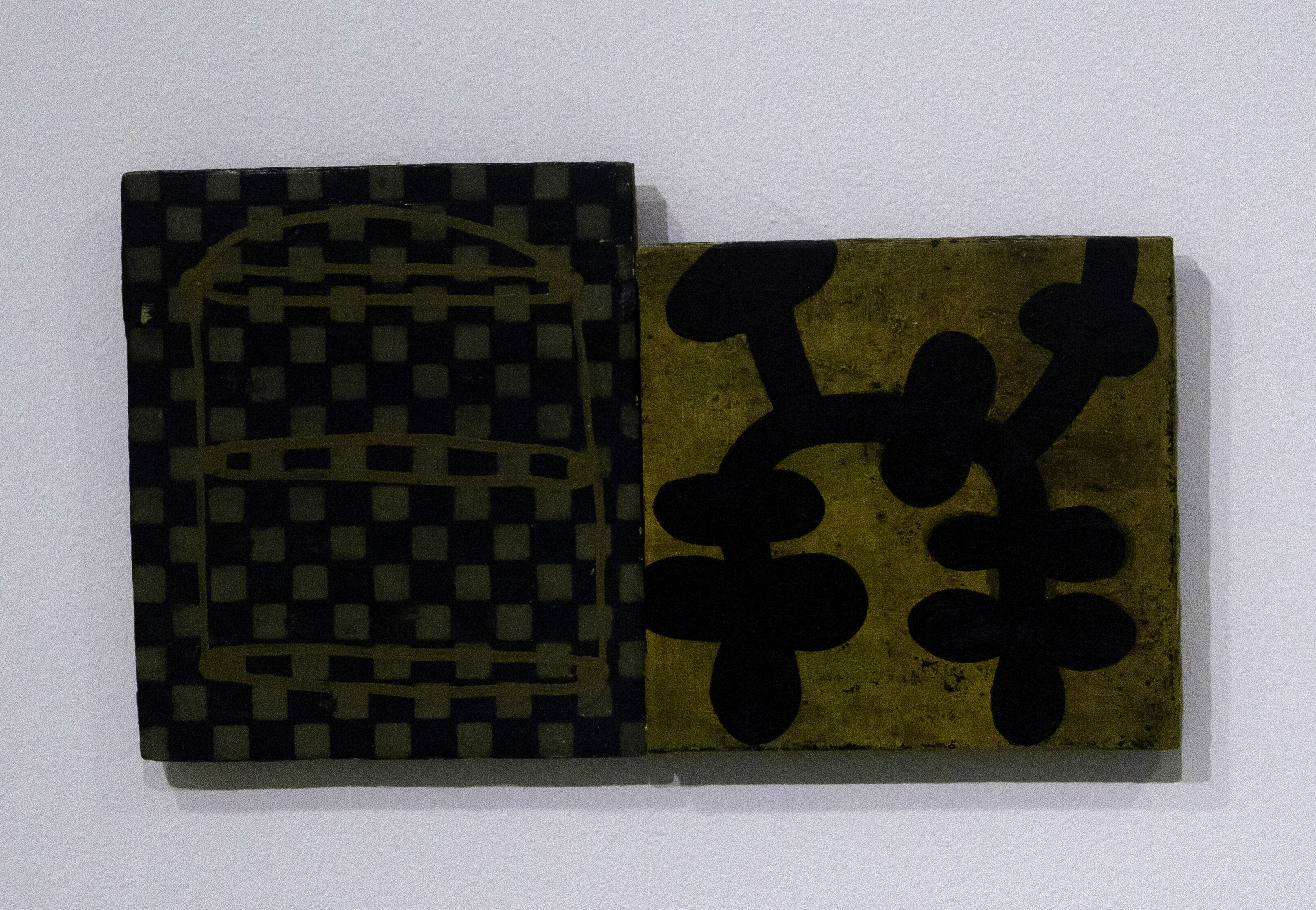
“Flesh Before Bones” is a two-panel oil painting by Barbara Klein, a recipient of grants and fellowships from the National Endowment for the Arts, the New Jersey State Council on the Arts, the Geraldine R. Dodge Foundation, the Mid-Atlantic Arts Foundation, the Marie Walsh Sharpe Foundation, and the Rutgers Center for Innovative Print and Paper making. The Lawrenceville, N.J., resident has held residencies at Yaddo, the MacDowell Colony, the Millay Colony, the Edward F. Albee Foundation, and the Virginia Center for the Creative Arts.
Her work -- generally painted on paper, canvas, or wood -- is striking for its unusual textures and colored patterns, according to Accola Griefen Fine Art. However, these bold abstractions are composed neither spontaneously nor quickly. She writes, “I juggle the position and placement of the components, until the right balance of color, weight, texture, and symbolic references has been achieved… My surfaces are compulsively worked and revised, sanded, and scraped, again and again until each piece has the right kind of visual history. This can take months, sometimes years, to accomplish.”
Victor Davson’s 1996 untitled graphite on paper seems to stare out from an eye amid a spiral galaxy. If eyes are the window to the soul, Davson’s soul seems to be messaging his inner turmoil. Born in Guyana, Davson came to New York in 1973, inspired by a lecture he’d heard about the Black Arts Movement. He held an artist-in-residence position at the Studio Museum in Harlem before going on to found Aljira, a Center for Contemporary Art in Newark. He spent more than 30 years there, promoting cross cultural dialogue and understanding. All the while the West Orange resident was actively pursuing his own career as a painter, moving through stages of cultural realism, political art, abstraction and landscapes.
Viewing the state’s extraordinary talent, you leave this exhibition feeling proud to be a New Jerseyan.


