Qualeasha Wood's Textiles Weave Together Digital Technology, Queer Identity, and Black Culture at Rowan University





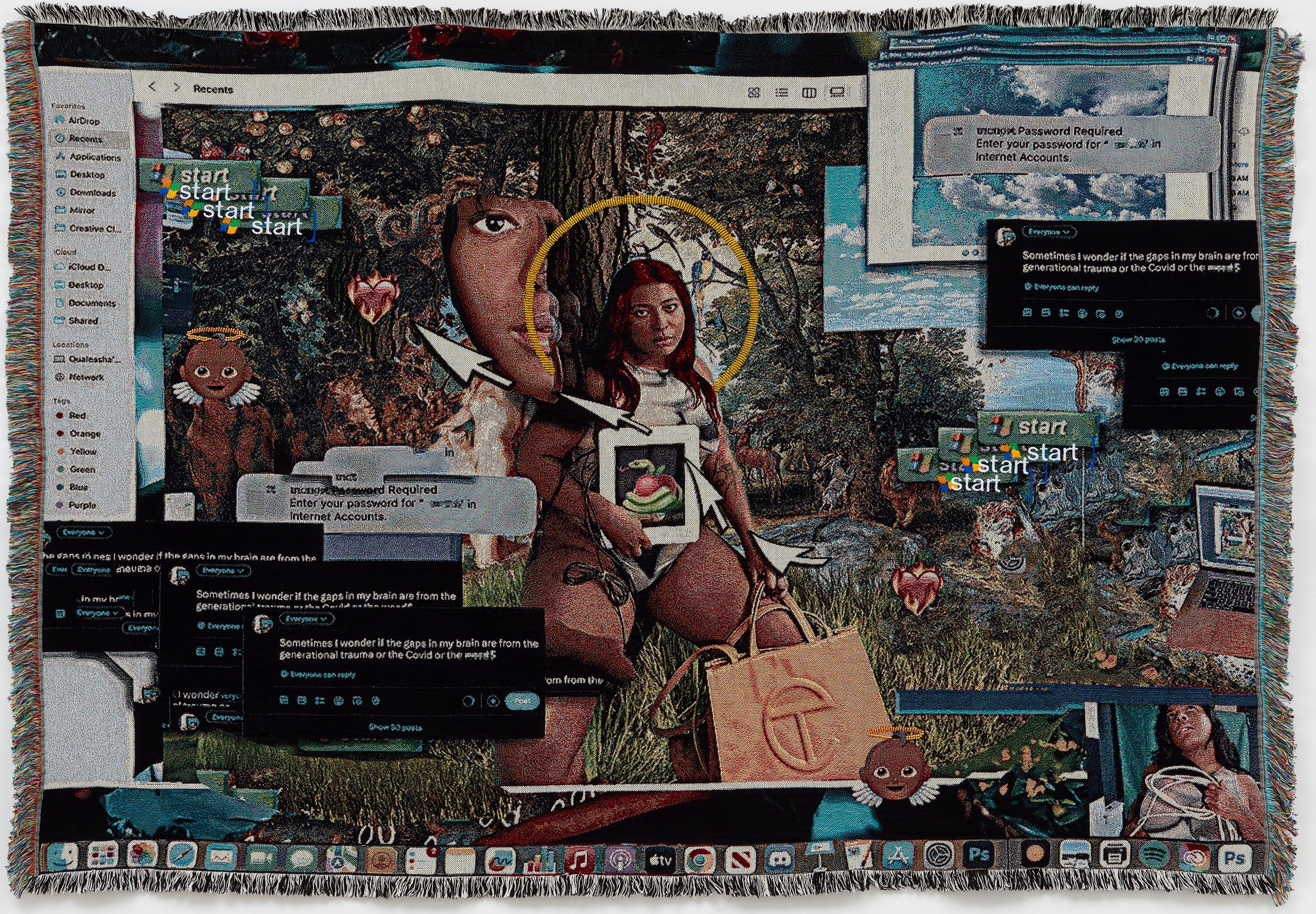
There is a common thread between the movies “Ex Machina” and “Barbie” in their analysis of what it means to be human and what is life's purpose. These themes are intricately woven into the tapestry piece “Deus Ex Machina” (What Was I Made For?) by world-renowned textile artist Qualeasha Wood. She draws inspiration from the existential questions posed in both films, reflecting on the struggles of the main characters to define themselves beyond predetermined roles and contexts. Through her jacquard-woven, machine-embroidered tapestry, Wood invites viewers to contemplate autonomy and the deeper meaning of existence in a technologically driven world.
“Deus Ex Machina” serves as an anchor piece in Wood’s latest solo exhibition, “code_eden,” which is on view until January 10, 2026, at the Rowan University Art Gallery & Museum in Glassboro, New Jersey. This marks a significant milestone—a regional debut for Wood, who is based in Philadelphia but was born in Long Branch.
Her “code_eden” exhibit features 11 distinct works, including tapestries, tuftings, and videos, all unified by their exploration of utopian and dystopian themes. The 29-year-old artist transforms the language of technology into lush landscapes, weaving into the fabric of her artwork such complex issues racial stereotyping, the pervasive influence of social media, and the evolution of internet culture.
In “Deus Ex Machina,” Wood takes us on a journey through the exploration of divine intervention and self-determination, blending the imagery of wildlife with symbols from both virtual and religious sacraments (e.g., a snake coiled around an apple). The background for this tapestry is actually inspired by the painting, “The Garden of Eden with the Fall of Man,” by Flemish masters Jan Brueghel the Elder and Peter Paul Rubens. By weaving in references to this famous artwork, Wood connects her reflections on the Garden of Eden and paradise. “In that piece in particular, I was interested in Eve as the first woman and the question of purpose, says Wood.” I had just watched the “Barbie” movie, (featuring) the Billie Eilish song (from the soundtrack), “What Was I Made For?” I really felt drawn to that question.”
Wood takes cues from “the concept of “deus ex machina” — a narrative device that introduces an unexpected, external force to resolve a complex situation,” says art historian and guest curator Leandra-Juliet Kelley, quoting Wood’s artist statement. “This device allows us to highlight the paradoxical position of Black women in society — cast simultaneously as both saviors (swooping in to save the day) and scapegoats (reinforcing harmful stereotypes and being blamed for societal problems) within a white supremacist framework.”
Wood’s body of artwork is a powerful reclamation of Black and Queer experiences, which have been appropriated online through memes, language, TikTok dances, etc., notes Kelley “Qualeasha's tapestry “Linguistics” explores this phenomenon. The work features popular memes, all of Black people, that have been shared numerous times online. The tapestry highlights the distortion that comes from these Black moments that are stripped from their context and viewed for entertainment,” she adds.
Wood’s new video art pieces, “Malware” delves into the world of glitches, exploring the duality of being vulnerable to threats but also susceptible to change, while “Visions of Life” integrates a digital version of Wood reminiscent of the characters from the video game “The Sims.”
A tufting piece, “Into the Blue,” visualizes the journey of adolescence and introspection through bold colors and pillowy textures. During the pandemic, Wood observed tufting, a textile technique utilizing yarn, as a growing trend among artists transforming logos and characters from shows like “The Simpsons” and “Pokémon” into custom rugs. This sparked her curiosity about whether tufting was limited to decorative or whimsical images, or could it convey narratives and personal stories within the woven threads?
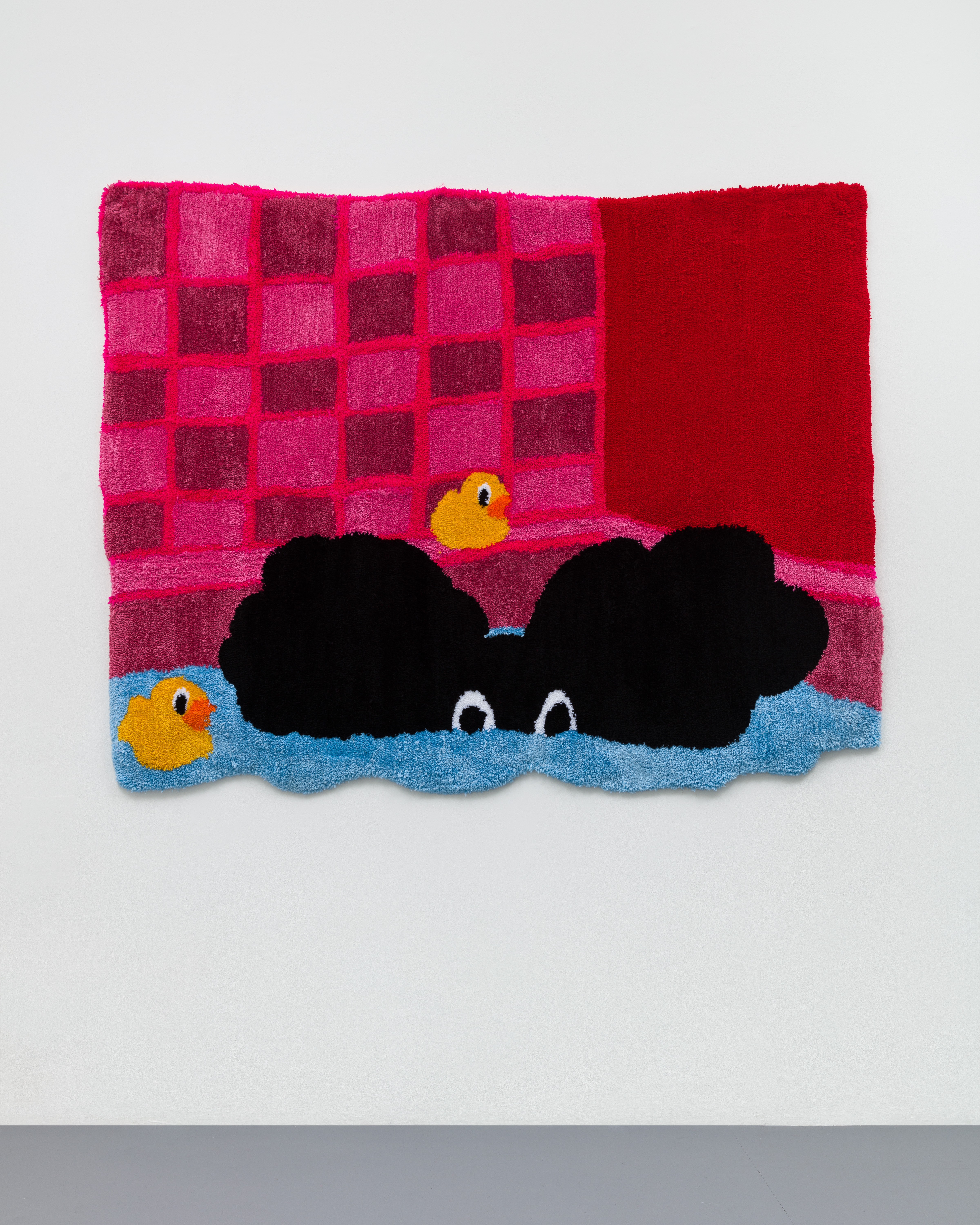
“There was this black, shadowy, non-fully rendered figure that I drew a lot in undergrad,” says Wood. “For me, that stemmed from a history of drawing myself as a kid using the black crayon. It was a black stick figure with puffy hair.’ She adds, “water and bath time represent spaces where you're the most vulnerable. I can’t swim and I would have these moments in the bathtub when I was younger in fear of drowning, but also in fear of my naked body being exposed.”
Drawing inspiration from childhood cartoons and viewing her experiences through the lens of animation, Wood transforms bath time recollections into visually engaging and psychologically resonant artwork. “Into The Blue” is a tufted wool and acrylic figure distinguished by expressive eyes and two afro puffs emerging from bath water, surrounded by playful rubber duckies. This depiction reinforces childlike reminiscence and vulnerability.
Becoming an artist was not a childhood ambition. In fact, Wood almost joined the military—both of her parents are veterans, so it just seemed like the natural path for her to follow. But then she took an art class and thought, “Okay, I’ll go to art school and become an illustrator, maybe even write a children’s book.” But she soon came to the realization she hated drawing. That’s when she discovered and fell in love with printmaking.
It was an interaction with Faith Ringgold, the mixed media artist best known for her narrative quilts, which led to the pivotal moment. “As somebody who grew up with her work, her quilts, and her storytelling, she was the first person I talked to about not wanting to draw anymore,” Wood explains. “She gave me the strength and courage to go into printmaking. She signed a copy of her book “Tar Beach” and wrote in it, "Dear Qualeasha, go fly and be a printmaker." I switched my major the very next day.”
Looking back, Wood says she always loved textiles as a kid. Instead of paintings, her family had rugs and textiles hanging on the walls at home. Her great-grandmother crocheted for her blankets and stuffed animals. The real turning point came during her college freshman year when she worked on a quilt, creating something tangible she could hold and wrap herself in.
To an extent, her artwork pays homage to the legacy and memory of the women in her family who crocheted and knitted. She recalls the time she visited her grandmother in South Jersey. “She gave me a jacquard-woven photo blanket of me, my brother and my cousins as babies. I couldn’t stop staring at it. I was just mind-blowing—the idea that an image could be woven, not just printed on fabric but actually embedded in it. There was something about it, both physically and conceptually, that felt really special to me.”
Then came the discovery of a historical link between computing and the craft of weaving. The Jacquard loom, the mechanical device in textile production operated using punch cards, laid the foundation for the binary code and paved the way for modern computers. This realization deepened the bond between Wood’s passion for weaving and fascination with technology.
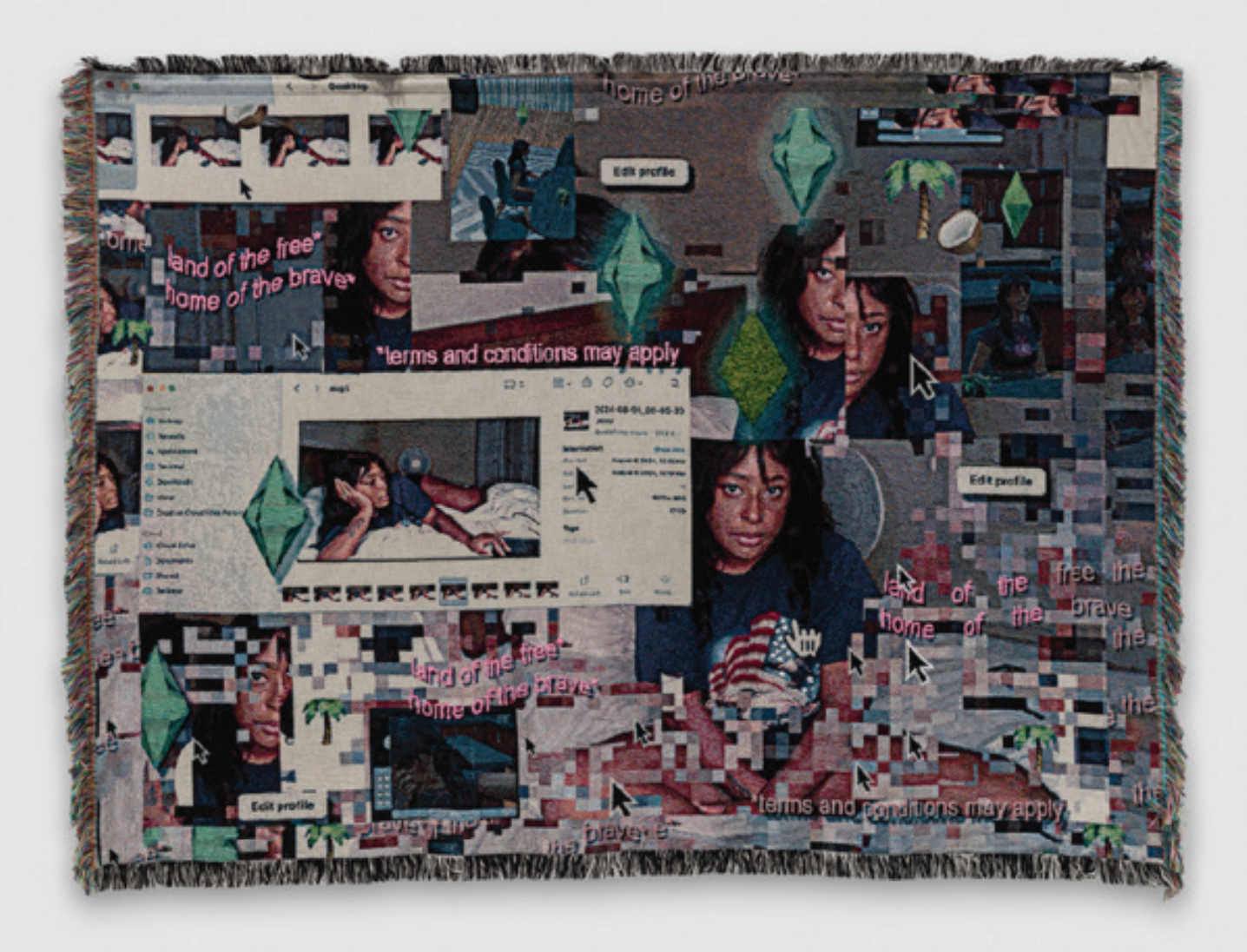
Her artistic process involves playing around with tools of the trade—iPhones, webcams and camcorders—to capture images, especially selfies. She combines digital technology with traditional craft techniques, hand-sewn embellishing, beading, and embroidering. She converts her files into a very specific pixelated color palette, processed through a digital jacquard loom, with each pixel representing a single stitch.
Wood’s latest collection is an expansion of her first exhibit, “code_anima,” which explored selfhood. The “code_eden” exhibit at Rowan University Art Gallery & Museum is free to the public. Kelley, who also curated “code_anima,” says she is “excited for people to see and experience these works, reflecting on the spaces that they inhabit in real life and online.”


