New Jersey State Museum Finds Common Denominators in Our Nation’s Anniversaries





As our nation gears up to celebrate the Semiquincentennial, or 250th anniversary of its birth, those of a certain age may hark back to the summer of 1976, when the Bicentennial, celebrating the nation's founding as an independent republic, consumed our attention.
Events like the tall ship parades in New York Harbor and the lighting of the Empire State Building in red, white, and blue, came with hopes of fostering national pride. There were fireworks, parades, and re-enactments. “Hotel California” by the Eagles – a band named after the national bird -- played on a device known as a radio.
With so many museums and historical societies planning events for the Semiquincentennial, the New Jersey State Museum decided to capitalize on the moment to look back at the Bicentennial, using works from its holdings to tell the story. Celebrating the distinct look and feel of 1970s America, the exhibition will be on view through February 2027.
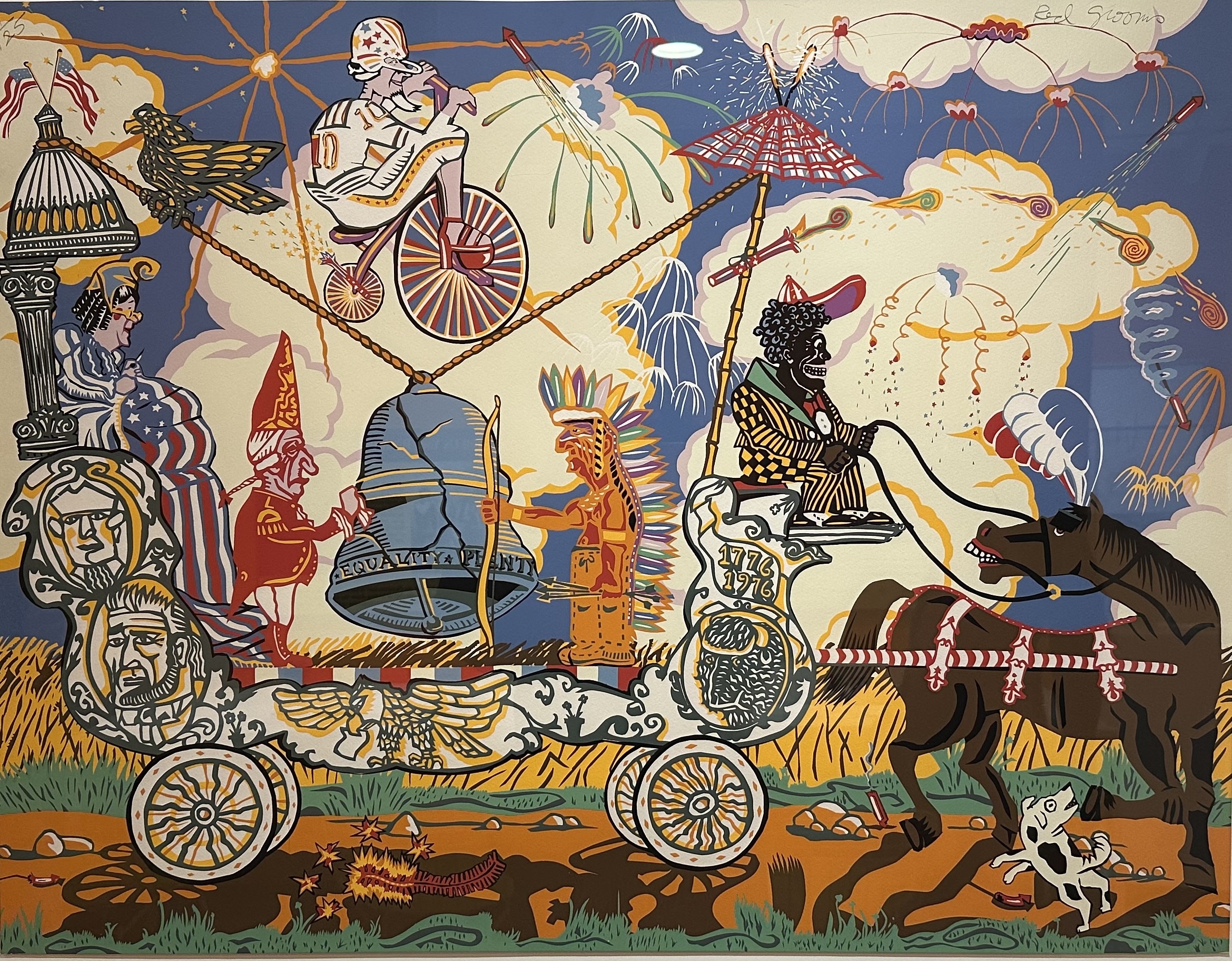
The exhibition combines history, material culture, and art, and includes work by such artists as Red Grooms, Alex Katz, Marisol Escobar, Jacob Lawrence, Robert Indiana, Ed Ruscha, and Audrey Flack.
“It was a challenging time,” says Curator of Cultural History Nicholas Ciotola. “In 1976, not unlike today, Americans were wrestling with issues of belonging, equity, and patriotism and channeled their feelings about the country in different ways – socially, politically, and, most importantly for this exhibit, artistically.”
In the midst of the turmoil of the early 1970s, officials looked to the Bicentennial as an opportunity for Americans to forget their differences and rally together around pride and patriotism for their shared country.
“Just because governmental leaders thought that the Bicentennial could be a rallying force for all Americans does not mean that it actually was,” continues Ciotola. “Then, as now, some people did not have cause to celebrate. The 1970s were a time of economic uncertainty (two oil crises, stagflation, inflation and high unemployment), increased distrust of government (Watergate and Vietnam) and racial, gender and economic disparity. For many Americans, the Bicentennial was background noise, masking serious problems in society.”
With 2.5 million artifacts, artworks and specimens in its collection, the museum can only exhibit a fraction of its holdings. “This exhibit provided an opportunity to show things that are being seen by our visitors for the first time,” continues Ciotola. “Often, material culture from the 1970s is viewed as kitschy and of a less-desirable aesthetic than things produced in other decades. That bias is one of the reasons we’ve not displayed this material in the past. But the occasion of the Bicentennial gave a perfect opportunity to cherish materials that have been overlooked.”
It was also a way to celebrate a national anniversary that would stand out. “Nobody was talking about the Bicentennial.”
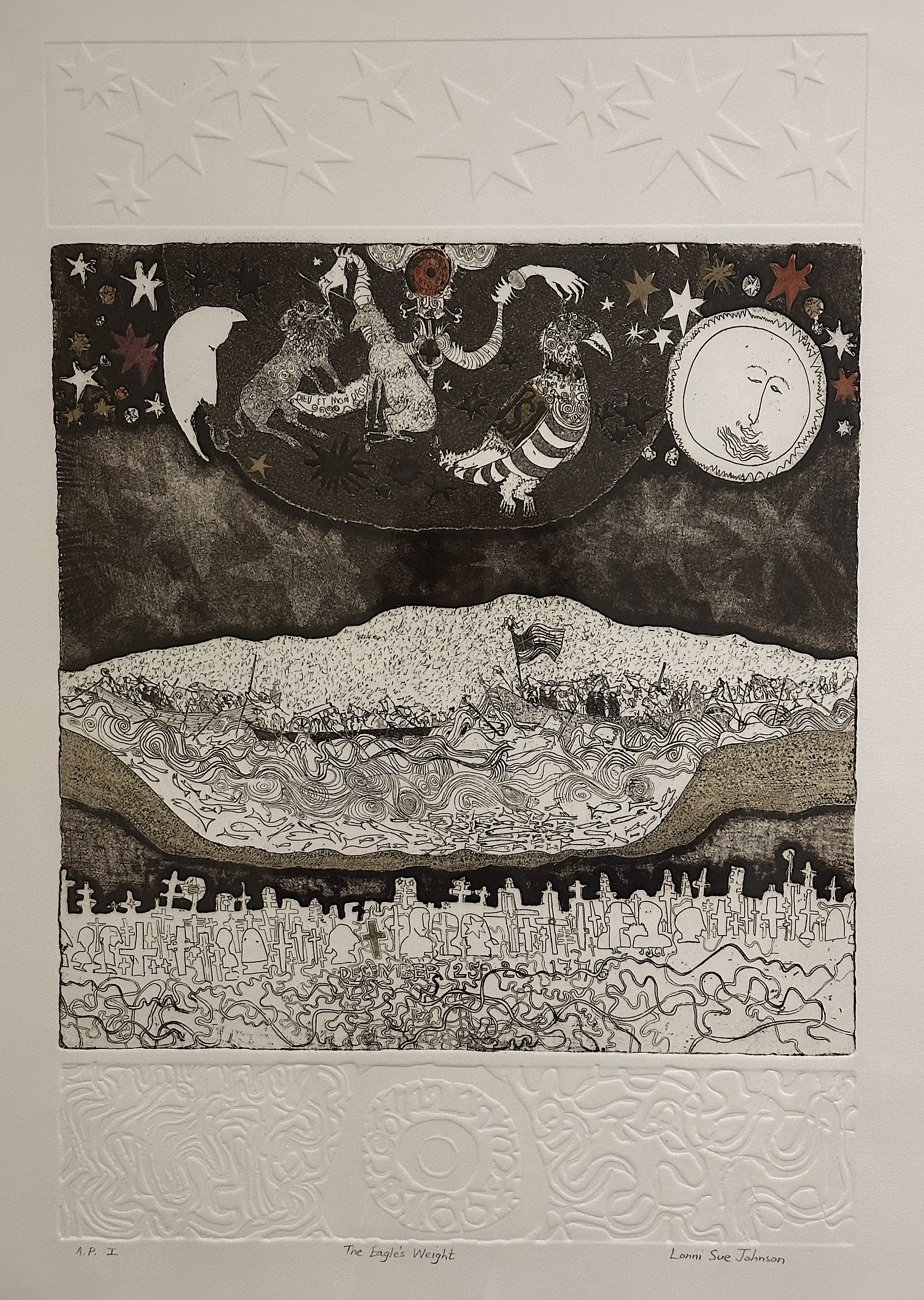
Greeting a visitor at the entrance to the gallery is Lonni Sue Johnson’s “The Eagle’s Weight,” an etching from the Ten Crucial Days Portfolio, referring to the pivotal time when George Washington and his troops turned the tide of the Revolutionary War with their much-celebrated crossing of the Delaware just north of Trenton. The portfolio was a project of the Princeton Printmakers collective, a group of women artists, many nationally known, that included Judith K. Brodsky, Marie Sturken, Joan Needham, Trudy Glucksberg, Yvonne Burk, Renee Levine, Ann Gross, Margaret K. Johnson, and her daughter, Lonni Sue.
Born in 1950, Lonni Sue Johnson, who regularly produced covers for The New Yorker and other major publications, illustrated more than 50 books (three of which she wrote) and has been featured in major museums, was 26 at the time of the Bicentennial and the creation of the portfolio. In “The Eagle’s Weight,” we see whimsically rendered animals of the Zodiac (including the eagle) in a bubble between the moon and the sun on a starry night sky. Below is a scene of Washington’s crossing the swirling icy waves of the Delaware, and below that, a cemetery with silhouetted heads iconic of Revolutionary era soldiers. (There were about 40 American fatalities and 275 British deaths in the Battle of Princeton.) The decorative embossed stars surrounding the scene make the connection between the stars in the sky and “the stars were still there” from “The Star Spangled Banner.” Although Johnson was just making her way as a commercial artist, the details of the linework that would become her signature style are evident here.
The Ten Crucial Days Portfolio was originally exhibited at the State Museum’s 1976 Bicentennial exhibition.
The other big print portfolio making up this exhibition is the Kent Bicentennial Portfolio. It was actually the Kent cigarette company that commissioned the works for the portfolio. Embracing the “Spirit of Independence,” the artists were given complete freedom to choose subject matter that would answer the question, “What does independence mean to me?” The portfolio became part of the collections of 100 museums, including the State Museum.
Katz’s portrait of George Washington portrays him in middle age – the founding father was 44 during the Battles of Trenton and Princeton. He is usually pictured as a wizened older man during his later years as president.
Voting rights, an issue once again front and center, was a subject for Jacob Lawrence in “The 1920’s – The Migrants Arrive and Cast Their Ballots.” Inspired by Lawrence’s own migration series, comprised of 60 paintings executed 35 years earlier, it conveys the sacred nature of exercising this right granted by the 15th Amendment.
In his signature way of using words, Ed Ruscha’s “America Her Best Product,” using Futura font, displays the letters that form “Made in U.S.A,” commenting on rampant American consumerism prevalent in the era.
“Some of the Kent Bicentennial works are critiques of America in a year intended to celebrate it,” says Ciotola. “Fritz Scholder’s ‘Bicentennial Indian,’ draped in a backwards American flag, suggests the irony of celebrating a country that destroyed its indigenous peoples. Red Grooms’ ‘Bicentennial Bandwagon’ includes caricatures of Native Americans, African Americans, and an American Bison juxtaposed with patriotic images like Betsy Ross, Abraham Lincoln, and a football player, all in the context of a carnival-like scene of Americans getting on the bandwagon of celebration. Grooms is asking, ‘How can we celebrate our history when people and animals were exploited and in some cases annihilated by our past?’”
Photorealist pioneer Audrey Flack also gives her take on consumerism in a screenprint of the kitschy items used to commemorate the Bicentennial. She seems to be suggesting that patriotism is consumerism.
Indeed, it was a “Buy-centennial.” One could purchase Bicentennial buttons, beers, Barbie dolls, belt buckles, baseball bats, even Bicentennial bibles – and those are just the things starting with “b.” According to the exhibition text, businesses saw it as an opportunity to combine patriotism and commercialization. Some argued that nothing was more patriotic than true American capitalism. Even Trenton’s esteemed potteries – Lenox, Boehm, and Cybis – got into the act, manufacturing commemorative bicentennial ceramics. According to the exhibition text, the pottery manufacturers were now in the hands of the founders’ children and grandchildren, who saw it as an opportunity to give back to the country that provided opportunities for their immigrant ancestors.
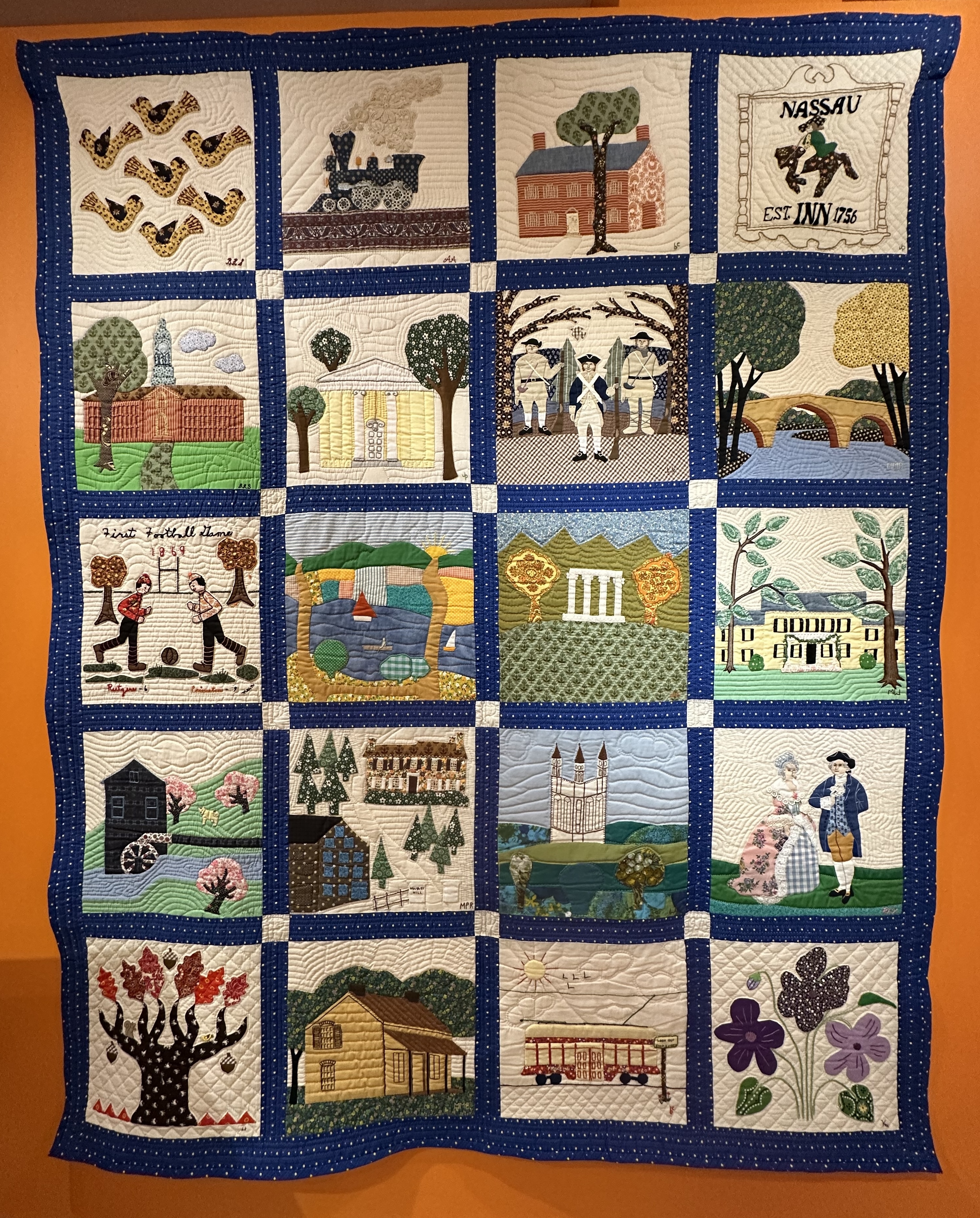
The Bicentennial coincided with the 1970s craft revival, celebrating the handmade over the mass-produced. (Peters Valley School of Craft was established in 1970 in the Delaware Water Gap National Recreation Area as an experimental craft community and school to promote education in fine handcrafts.) Pottery, woodworking, printmaking and fiber arts flourished. Artists embraced natural materials, and quilt-making was one way to express oneself through color, pattern, and stitching techniques.
The museum boasts an extensive collection of quilts. Historically, “quilts were almost exclusively made by women, often in community or family groups but most often in religious groups,” says Ciotola. Chintz and calico, imported from India, were available in local communities. Prior to the Industrial Revolution, everything for the home was made by women. Then, as people grew wealthy, they could buy things from a store and so quilting died out, but the 1970s saw a revival of interest.
“It was tied to the counter culture, back-to-the-land movement,” says Ciotola. “People were finding quilts in attics and basements and quilting guilds started to form.”
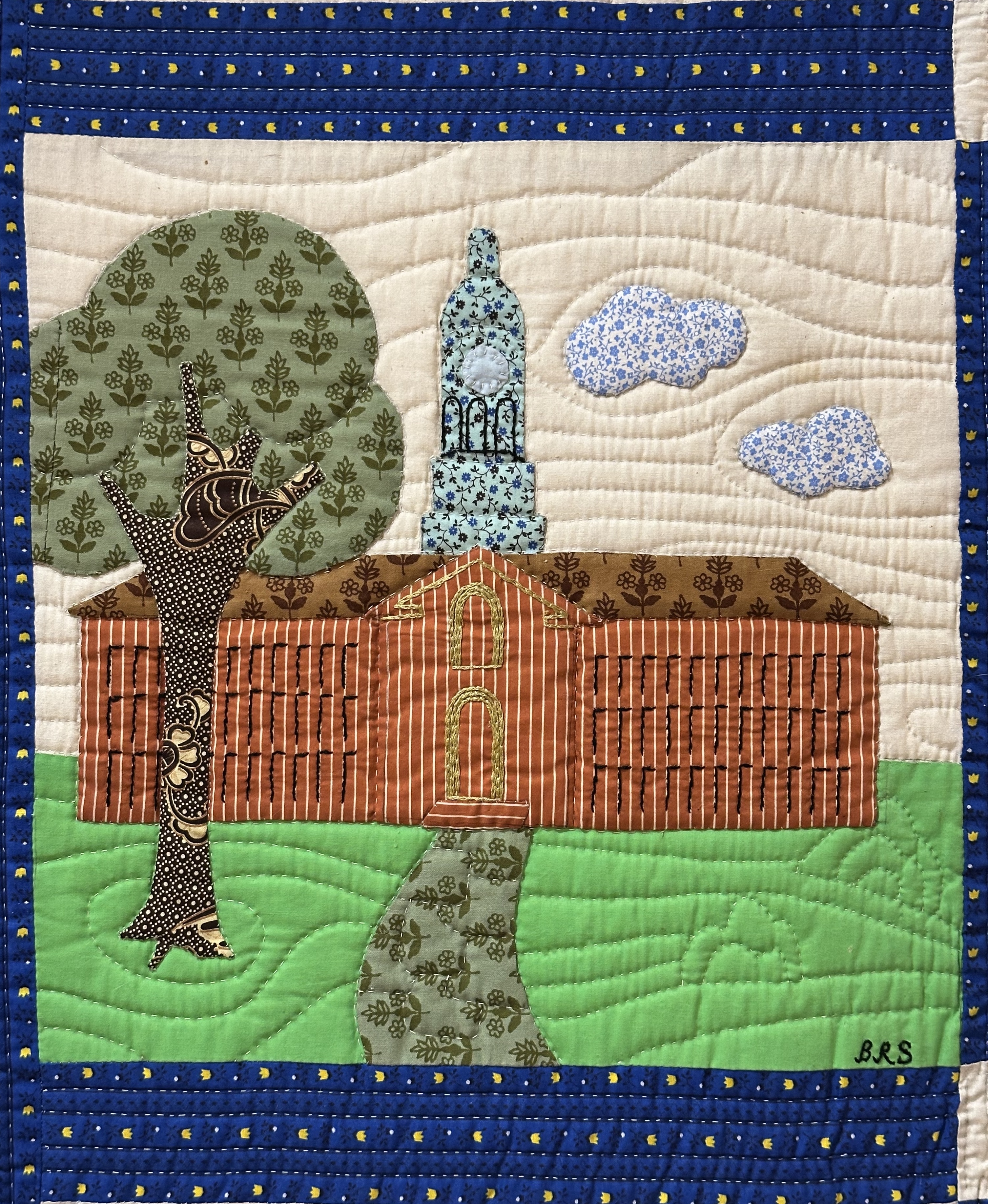
A group of women in a quilt-making class at the YWCA Princeton decided to celebrate the Bicentennial with an album quilt, made up of blocks of patterns. Traditionally, the subject of such blocks might be tied to family history, but for the Princeton Bicentennial Quilt the women selected images relating to Princeton: the Mercer Oak, Bainbridge House, Nassau Hall, Princeton Battlefield Park, the Quaker Meeting House, and George and Martha Washington.
The fervor of the Bicentennial did, indeed, beget more fervor, and with newfound patriotism, there was increased demand for American flags. Annin & Co. of Verona, N.J., was one of the major suppliers of flags for the Bicentennial. Ciotola debunks the myth that the first American flag was designed by Betsy Ross. Francis Hopkinson, a Bordentown resident as well as a Signer of the Declaration of Independence, deserves the credit for the stars and stripes and for choosing red, white, and blue.
Annin was named the official producer of the Bicentennial flag, made from an extra-durable nylon called Nyl-glo. The Bicentennial logo, with stars and stripes in red and blue, is featured on a white ground. About that logo: it was designed by William Galbreath of Pompton Lakes, an art editor for Forbes Magazine. Among the judges for the logos was Leah Schloshberg, then director of the State Museum.
While it was hoped that the Bicentennial would bring people together, it also highlighted the fissures. When more than a million gathered in Philadelphia to hear then-President Gerald Ford speak about freedom, unity, and the greatness of the country, protestors marched to call attention to racial and economic inequality. The Clinton Street train station in Trenton was a pre-event rallying point for those protestors arriving by train.
Protestors wore T-shirts that read: “We’ve carried the rich for 200 years. Let’s get them off our backs.”
Similarities between the Bicentennial era and now are easily drawn. “Economic inequality, inflation, affordability, distrust in government, racial injustice, troubles in the Middle East,” says Ciotola. “What it comes down to is that we are all Americans. Anniversary years afford us the opportunity to reflect on what it means to be Americans. For some, it will be a time to fly a flag and be thankful for how much they have. For others, it will be a time to draw attention to problems that we still face and that yet need to be resolved.”
For those who come to see this exhibit, “we just want them to reflect on this one small aspect of the history of their state and we hope that their visit evokes pride in being a New Jerseyan, regardless of their political views.”


