Hunterdon Art Museum Summer Exhibition Explores the Possibilities of 'Pulp'





One of the wonderful aspects of visiting a museum this time of year is seeing the profusion of young children filling the galleries, whether with camps or family members. Their collective voices echoing through the corridors convey curiosity. It’s a reminder that they will go on to cultivate, continue, and create on the traditions.
Pulp: The Fluid and the Concrete, on view at the Hunterdon Art Museum through August 31, offers just such an opportunity for young people to learn about the ancient traditions of papermaking, a medium they can literally dip their hands into, and for people of all ages to appreciate on an aesthetic and cerebral level.
Writes one visitor in the comments book about the exhibition: “Tactile! Playful! Sculpted color! Deliciously messy!”
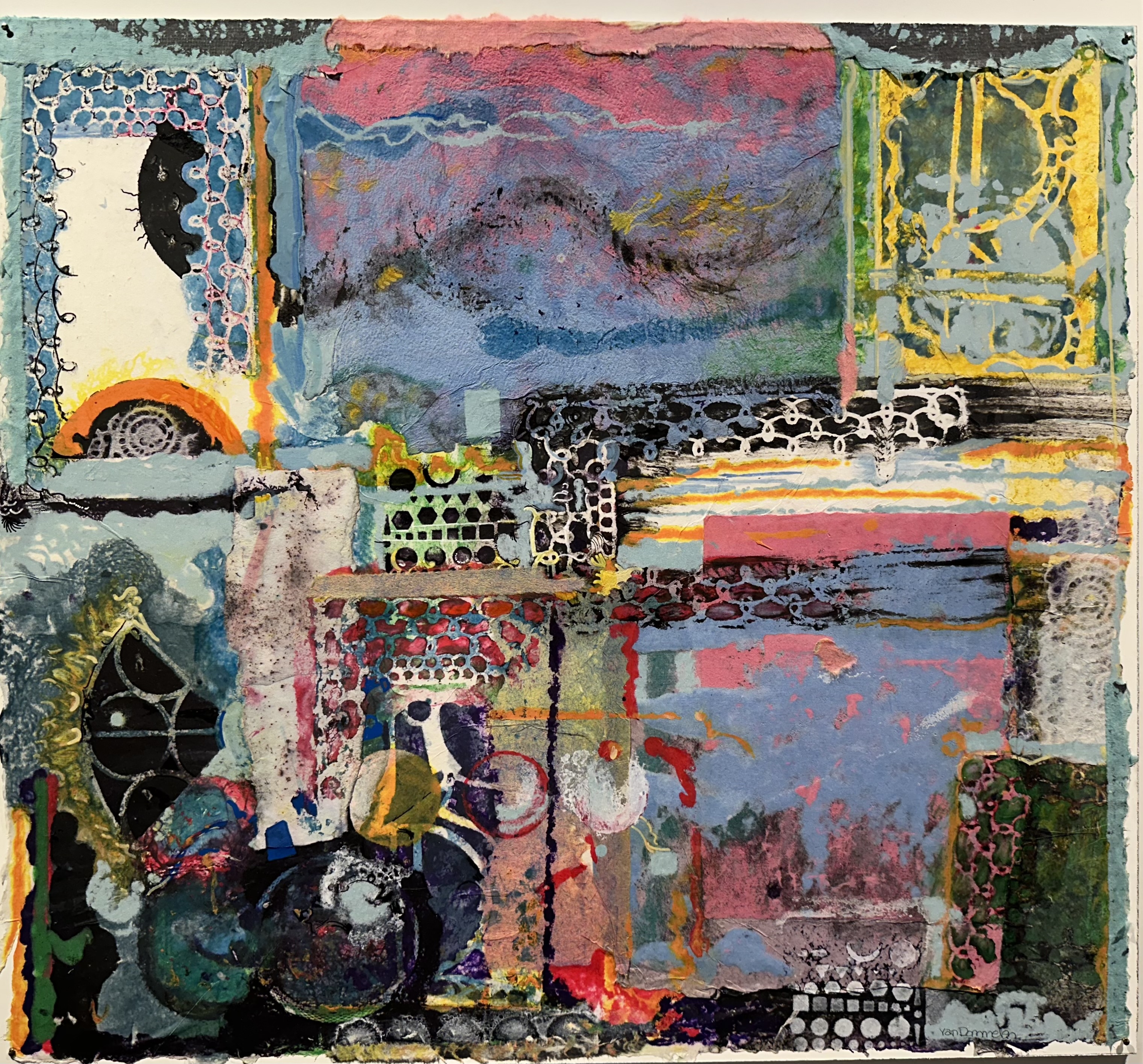
Greeting a visitor as she climbs the stairs to the second-floor gallery is Annelies van Dommelen’s 2023 work in abaca and handmade paper. Van Dommelen often works in mixed media, creating labyrinths of alluring imagery, and this is no exception. Abaca, I learned from Google’s AI-guided search function, sometimes known as Manila hemp (though not a true hemp), is a strong, natural fiber derived from a plant related to bananas. It's primarily used for making durable paper, ropes, and textiles. Come to think of it, this untitled work does look like a textile, with lace and other cutout shapes resembling chain links. There are hidden treasures to find in this blend of papery materials.
Exhibition co-curators Gail Deery and Cynthia Nourse Thompson were invited by the museum’s former executive director, Marjorie Nathanson, and Judith Brodsky, founding director of the Brodsky Center at PAFA.
“This exhibition features a carefully curated selection of artworks that highlight the diverse applications of handmade paper,” says Deery, and includes sculpture, artists' books, collaborative print projects, and a site-specific installation. Many of the works were produced at the Brodsky Center, originally located at Rutgers, where both Thompson and Deery served as collaborators and facilitators of print and paper editions.
The artists represented are regional, national, and international, representing a cross-section of visual artists working in handmade paper, says Deery.
The Brodsky Center is one of two studios that have introduced artists to the creative potential of hand papermaking, Dieu Donné Paper being the other. They “have transformed the artistic landscape and changed how creatives approach their craft,” says Deery. “By championing the use of handmade paper, they have inspired and continue to inspire artistic innovation, making this exhibition an invaluable experience influenced by their vision.”
Among the many applications of pulp to explore in this exhibition is Roberto Mannino’s portrait series – six ovals, like icon portraits, albeit with classical Roman statues, inspired by the artist’s Italian heritage, according to his comments reached via QR code. These are contact printed onto linen pigmented handmade paper. A video nearby shows him mixing pulp, pouring it into molds, “couching” it onto a support, drying it, and hanging it.
Sarah Brayer’s “Yellow Taxi” is an arresting image of a lone figure at a street intersection at night, lit by a lamplight, standing before the eponymous yellow taxi. It is an example of how pulp can be used to “paint.”
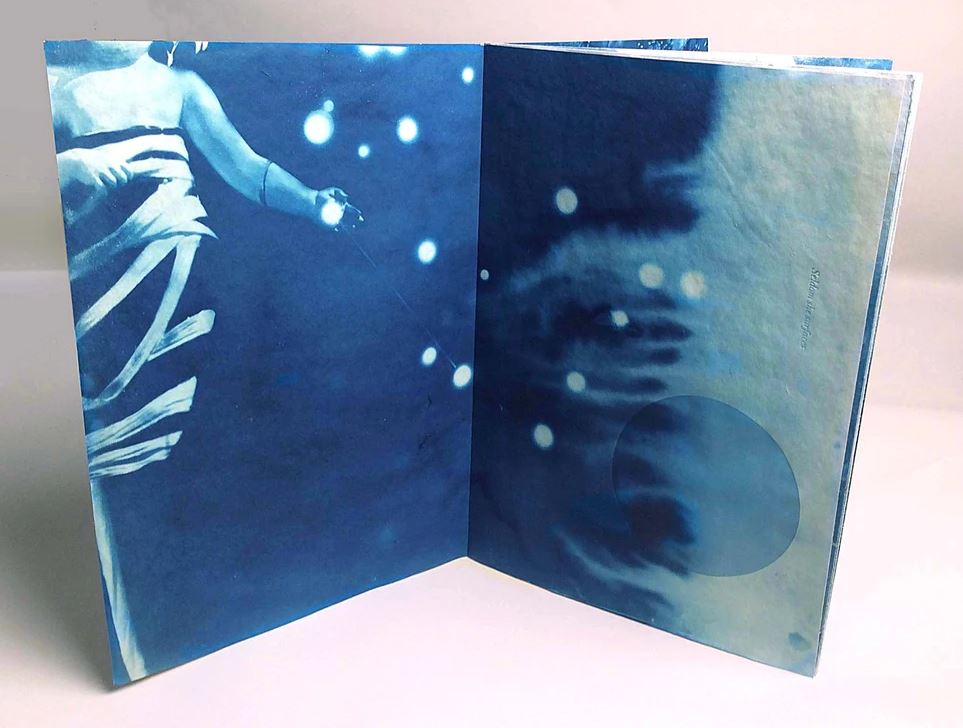
Stephanie Slate combines cyanotype with letterpress and silkscreen printing in two artist’s books here. She primarily uses alternative and historical photographic processes to explore darker themes such as loss, death, the afterlife, and the unknown. She says she uses cyanotype “because it is so forgiving… I use it in a fluid manner, like paint rather than photography.”
Here, she was inspired by her experience as a new mother visiting a hospital in Italy, formerly an orphanage. She experienced “fear of losing myself (identity) as a mother and fear of losing my daughter,” she says in comments also accessed via QR code.
Swaddled babies appear to float “in constellations,” while “blissfully becoming untethered” is printed in white against the Prussian blue.
Speaking of constellations, nearby is Luca Buvoli’s “Astrodoubt and the Quarantine Chronicles: Eggxit,” a woodcut print with chine colle (a printmaking technique where a thin piece of paper, often decorative, is bonded to a heavier sheet during the printing process) on handmade paper. Mysterious fractured orbs appear in the night sky.
Melanie Mauro also uses cyanotype in “Decorum” 1&2 (from an artist’s book), addressing societal expectations of women’s roles. Imagery is derived from lace doilies and blue and white china. “I… explore the feminine sphere,” she writes in a statement. “Drawing from historical texts about and by women, my works are studies of the female body and mind, and of women’s traditional domestic and societal roles.”
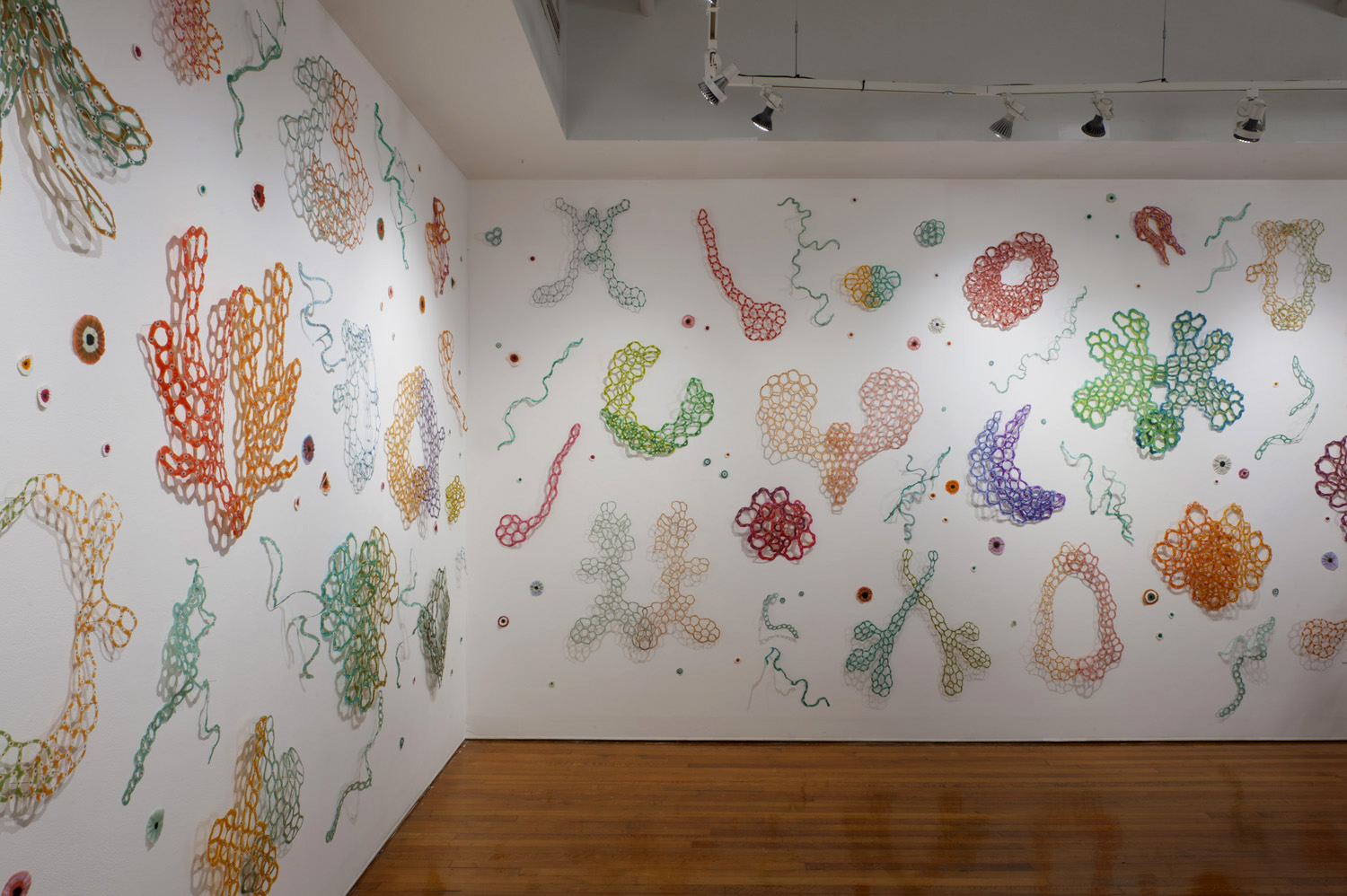
In the smaller adjacent gallery space is an installation by Michelle Samour, a multi-media artist whose installations, drawings, and handmade paper works explore the natural world through science and technology. Samour established the papermaking program at the School of the Museum of Fine Arts at Tufts University in 1983 and led it for several decades.
Here she works in pigmented abaca and other materials, creating beautifully colored amorphic shapes on all four walls, suggestive of primitive life forms – abstracted frogs, butterflies, octopus, snakes, starfish. “The organisms are covered in eyes, giving life to their fossilized remains… attached to the wall with specimen pins, they suggest a natural history collection,” she says.
Jeanne Brasile, the Hunterdon’s brand-new executive director, stopped by to introduce herself. She started her position after Pulp was in place but her head is already swimming in ideas for future exhibitions.
“I love working in a museum that is housed in a historic building,” says Brasile, dressed in colorful attire that augurs a colorful future for the museum. “I have worked in many white cube galleries, and I enjoy having the mill context in conversation with the artwork on display. It leaves room for richer conversations between the building, its history, and the present day.”
Mills “once contributed to a vibrant industrial economy but are now obsolete,” Brasile continues. “These buildings once housed dozens of workers and noisy, mechanical machines that produced goods like ground grains, yarn, thread or woven goods that were once necessary to everyday life. Now the activity in this mill is for enjoyment and leisure; it is no longer a place of hard labor and toil.”
She plans to “continue engaging in this conversation between history, craft, design and of course, art in our exhibitions and programs… we want to continue developing exhibitions and programs that explore this history and its present-day conditions.”


