The Hunterdon Art Museum Celebrates 250 Years of Women Raising Their Voices





As institutions gear up to celebrate the nation’s 250th, the Hunterdon Art Museum is not just going back in time but looking to where we are today – where our history as a nation has brought us. For its Semiquincentennial Exhibition: Contemporary Artists Respond, on view through April 26, the museum invited six regional artists to create new work on themes such as diversity, liberty, justice, equality, migration, land, and resources.
“The resulting exhibition provides an artistic lens through which to understand our history, not as a distant concept but as a continuous flow of influence that shapes our identity in the present,” says the introductory statement greeting visitors to the second floor of the historic mill building. These artists “address a variety of concerns and perspectives,” emphasizing that the anniversary “is not merely about looking back, but continuously re-evaluating the past, engaging with the complexities of the present and envisioning the future.”
Former Executive Director Marjorie Nathanson set the exhibition in motion, selecting the artists and the themes. With a grant from Hunterdon County to enable the commissioning of new work, current Executive Director Jeanne Brasile has seen it to the finish line.
All six of the artists are women. “Most of our shows champion women,” says Brasile. “We are intentional about giving women more exposure.”
Many of the museum’s exhibitions have shone a light on fiber artists, long before fiber arts were given their due in the art world. The museum’s leadership never drew a line between fine art and craft.
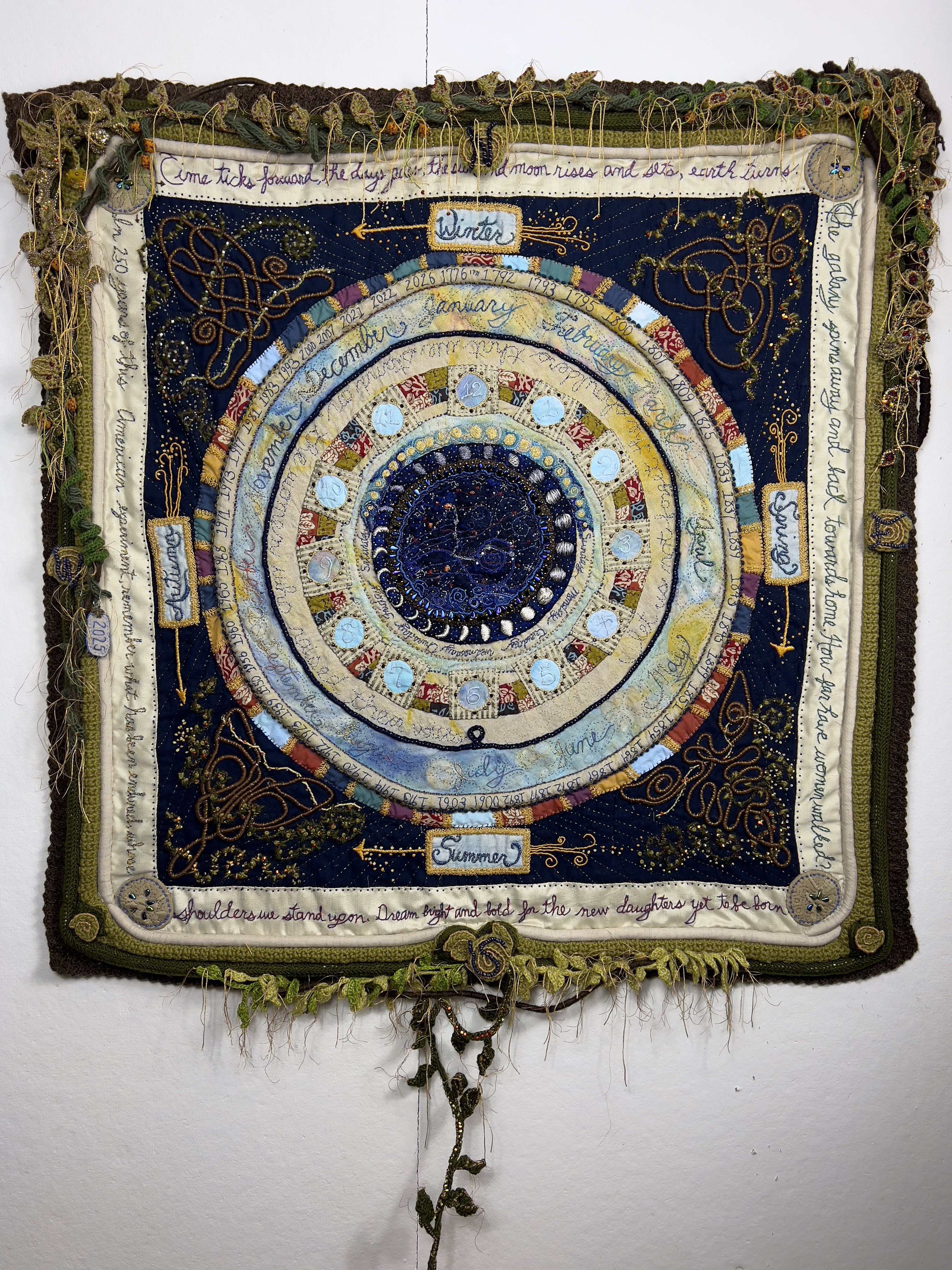
Brasile, an artist and one-time adjunct professor and gallery director at Seton Hall University, extolls the level of detail that fiber artist Bonnie Berkowitz poured into her work here, “Time Traveler’s Calendar.” Berkowitz is no stranger to the museum. Her intricately crocheted suit of armor, “Woman Rise Up,” first exhibited at the Hunterdon, went to last year’s Fiber Arts International Exhibition at the Contemporary Crafts Center, Pittsburgh, where it received further acclaim.
Berkowitz, who is also an art therapist, says she considers material to be as important as content. She was “fully engaged with wool, thread, and fabric” in creating her piece for this show. At its center is a galaxy – with its concentric rings, it seems to be asking, what is our place in the universe? One of those rings is a clock, indicative of the passage of time. “Time ticks forward” is embroidered into the piece, along with the seasons and the days of the week.
Among the other embroidered messages: “How far have women walked,” and “In 250 years of this American experiment, remember what has been embroidered. Let us not forget the shoulders that we stand upon, the women who raised their voices. Dream bright and bold for the new daughters yet to be born.”
It’s a reminder that women have always embroidered their wisdom into cloth, though it wasn’t given its due, relegated as “women’s work.” “Such work was often done in community, such as at a church, but those communities have now fallen by the wayside,” says Brasile.
As “the external world has continued to spin in a whirlwind… I turn to artmaking, as it is good medicine,” Berkowitz says in a statement. “The elements of fiber and glass, wool and hook, needle and thread, has fed me, in quiet hours, stitching, sewing and expressing what I am unable to say with words. Within the cotton and wool, I leave a trail.”
Techniques employed by Berkowitz to create this mandala include quilting, felting, dyeing, crochet, and beadwork. And as magnificent and detailed and poignantly poetic as it is, it is only part of Berkowitz’s installation. A crocheted and beaded vine winds its way down to a vintage suitcase, lace gloves, and a sepia photograph of her grandmother as a child, a reminder of her grandparents’ arrival to this country.
On another wall is a sash, “Say Her Name,” embroidered with “Sacajawea,” “Harriet,” “Sojourner,” “Mother Jones” and others.
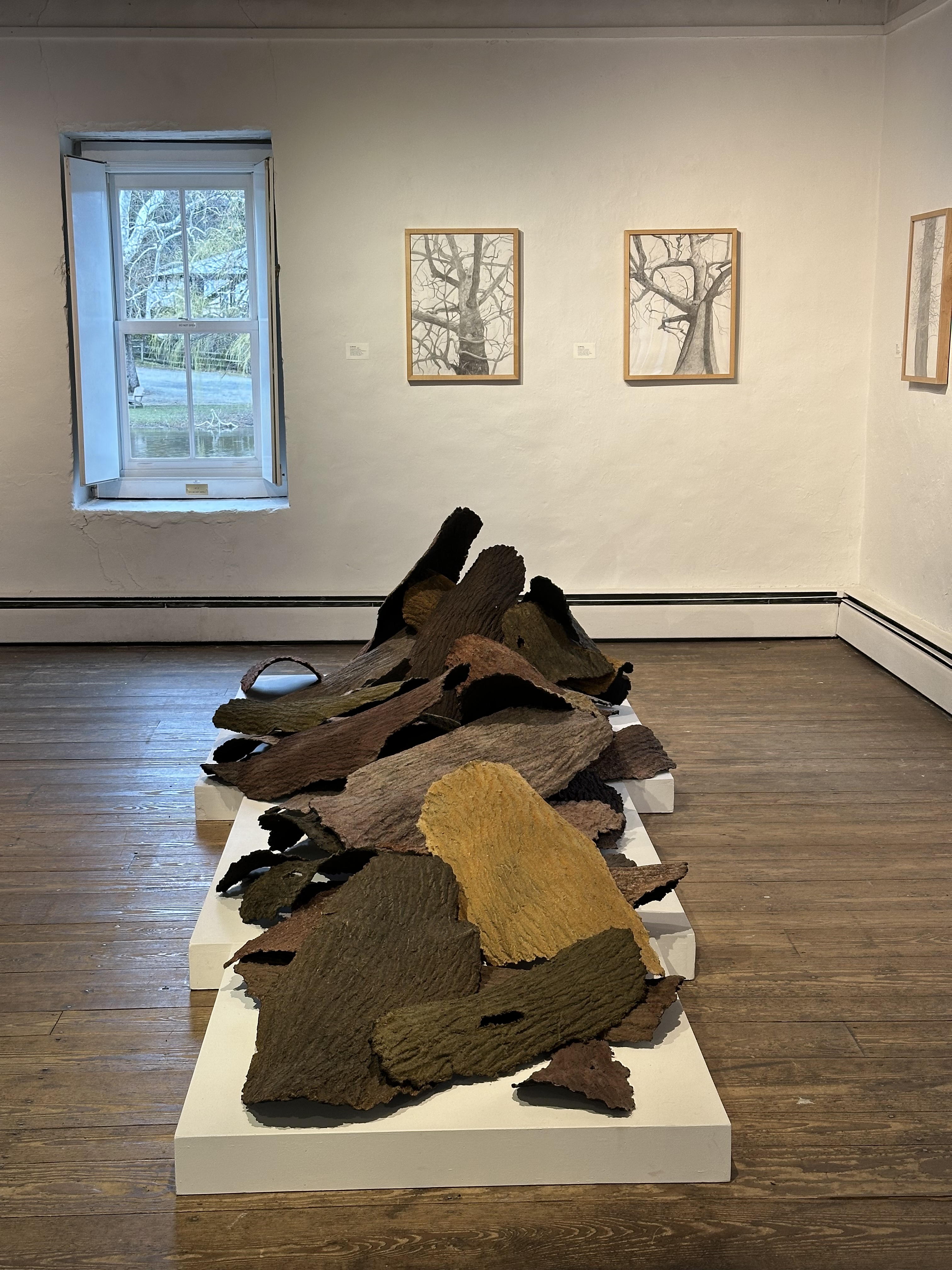
Artist Liz Mitchell, also no stranger to the Hunterdon Art Museum (her “Paper Boats” project was exhibited here in 2023), is primarily known for her work in handmade paper and book arts. The internationally exhibiting artist begins all her work with extensive research, then finds the materials to best express what she wants to say. Here we see, at the center of the gallery, a pile of tree bark in richly earthen colors. My first thought was: Were any trees harmed in the making of this installation?
But Mitchell did not go out in the night and denude these magnificent sentinels. Looking as soft as animal hides – their curvature even suggests the soft folds of furry creatures -- these coats of bark are made from cast paper. “They are pigmented pulp,” says Brasile. “Just as we vary as people, so do trees and their variety of bark, such as black gum, sycamores, and white oak.”
On the walls surrounding the installation are Mitchell’s hand-drawn trees. A one-time social worker who went on to study ceramics as a way of offsetting the challenges of that work, Mitchell has a drawing practice as well. These detailed line drawings evoke the human qualities of trees: their mothering protection in the shelter of their branches, the wisdom of gnarly, wizened trunks.
“Each drawing is a result of time spent sketching, documenting, and listening,” she writes about her “Silent Sentinels of History: Witness Trees of Hunterdon County.” “These are historic landmarks and living community memorials. Some once marked meeting spaces and others stood by as towns rose around them. Some have lived for over 250 years.” They are, indeed, the silent witnesses of our nation’s history. “And our future,” Mitchell adds. “Many now face threats from invasive species, disease, and environmental stress.” She hopes to not only pay tribute but strike a call to action “to protect the trees we still have, to remember the ones we’ve lost, and to honor those that continue to witness our unfolding story.”
In 250 years, we have developed as a nation of immigrants. Heejung Kim, a native of South Korea, “expresses the beauty of diverse people who have come to New Jersey, enriching it with their presence and cultural practices,” says the exhibition text. The theme she chose: Movement of People: Identifying the factors that made New Jersey a tapestry of cultures. Her wall of 50 food-serving vessels, wrapped in linen evocative of the flags of different countries – Mexico, India, Jamaica, Brazil, and India among them – represents the 50 states. “It’s fun trying to decode them and get at the unseen,” says Brasile. “What’s inside them is more than meets the eye, just as with people if you don’t take the time.”
“Even though their appearances may be different,” Kim says of the elements, “their essence as human remains the same.”
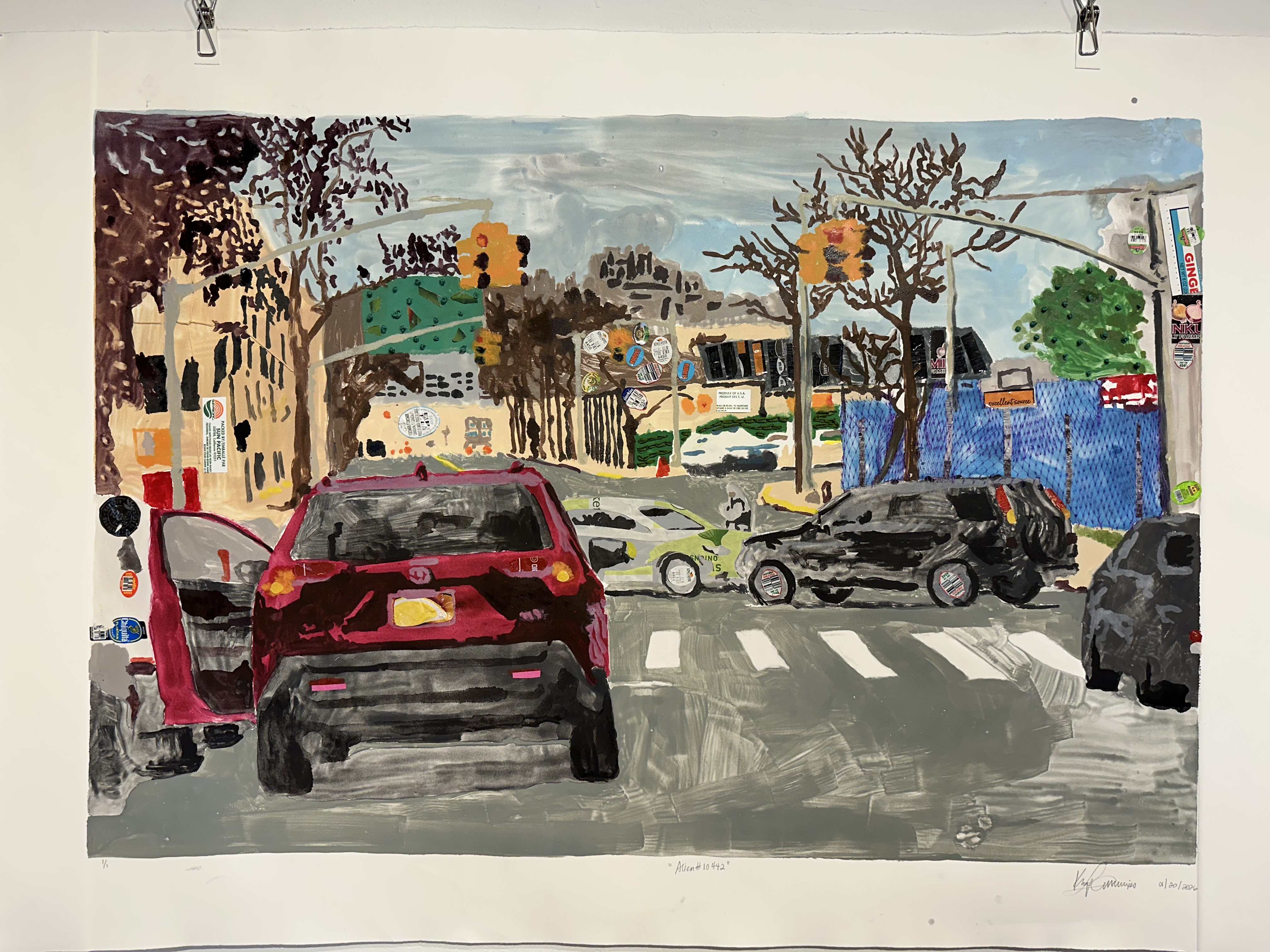
Jamaican immigrant Krystle Lemonia responds to the moment, says Brasile. “She is thinking about ICE raids and people being disappeared, driving while Black. These people make our country run. She is asking, ‘What happens when they go away?’” In one of Lemonia’s brightly colored embroidered monotypes of urban scenes, cars appeared to have just been stopped, searched. It evokes recent events in Minneapolis.
Lauren Rosenthal McManus collaborated with local schoolchildren to create a large-scale participatory map of the Raritan River Watershed, using locally gathered earth pigments. “The participatory process at the heart of this work embodies revolutionary ideals of civic engagement and shared responsibility,” she writes.
Elie Porter Trubert has filled the small gallery on the second floor with blue cyanotypes on which asemic writing (wordless, illegible mark-making that resembles handwriting) tell the story of the Musconetcong River and the people who call the area home. “Where did my neighbors or their ancestors come from? What decisions brought them here?” she asks.
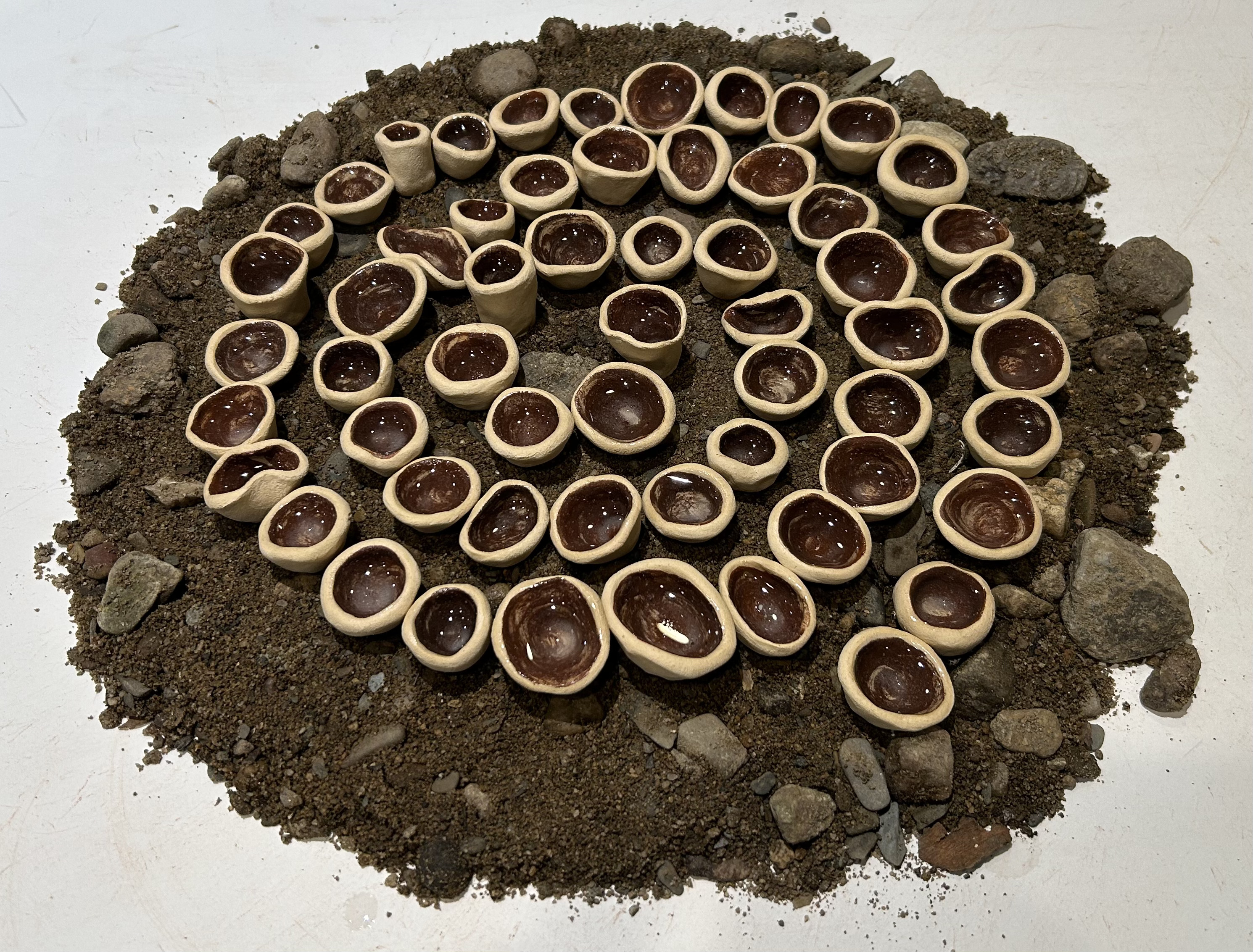
In each of the gallery’s window wells, with views of the Raritan River, are arranged of 231 pinch pots made with local clay. That is the estimated number of ethnicities in New Jersey, says Trubert.
“Collectively,” says Brasile, “these artists bring nuanced, personal, and community-centric insights to a national milestone, enriching the conversation around what it means to mark 250 years of American history.”


