The Hard Work of Play at the Montclair Art Museum




As far as childhoods go, artist Tom Nussbaum had an ideal one, brimming with elements to grow an artist. His British mother, a nursery school teacher, engaged her children in such activities as building gingerbread houses, and his father, an electrical engineer and physicist, tinkered in a basement workshop where, at his side, young Tom learned to make things using tools. He was given free rein and by age 10, was creating toys from erasers, paper clips, and paint.
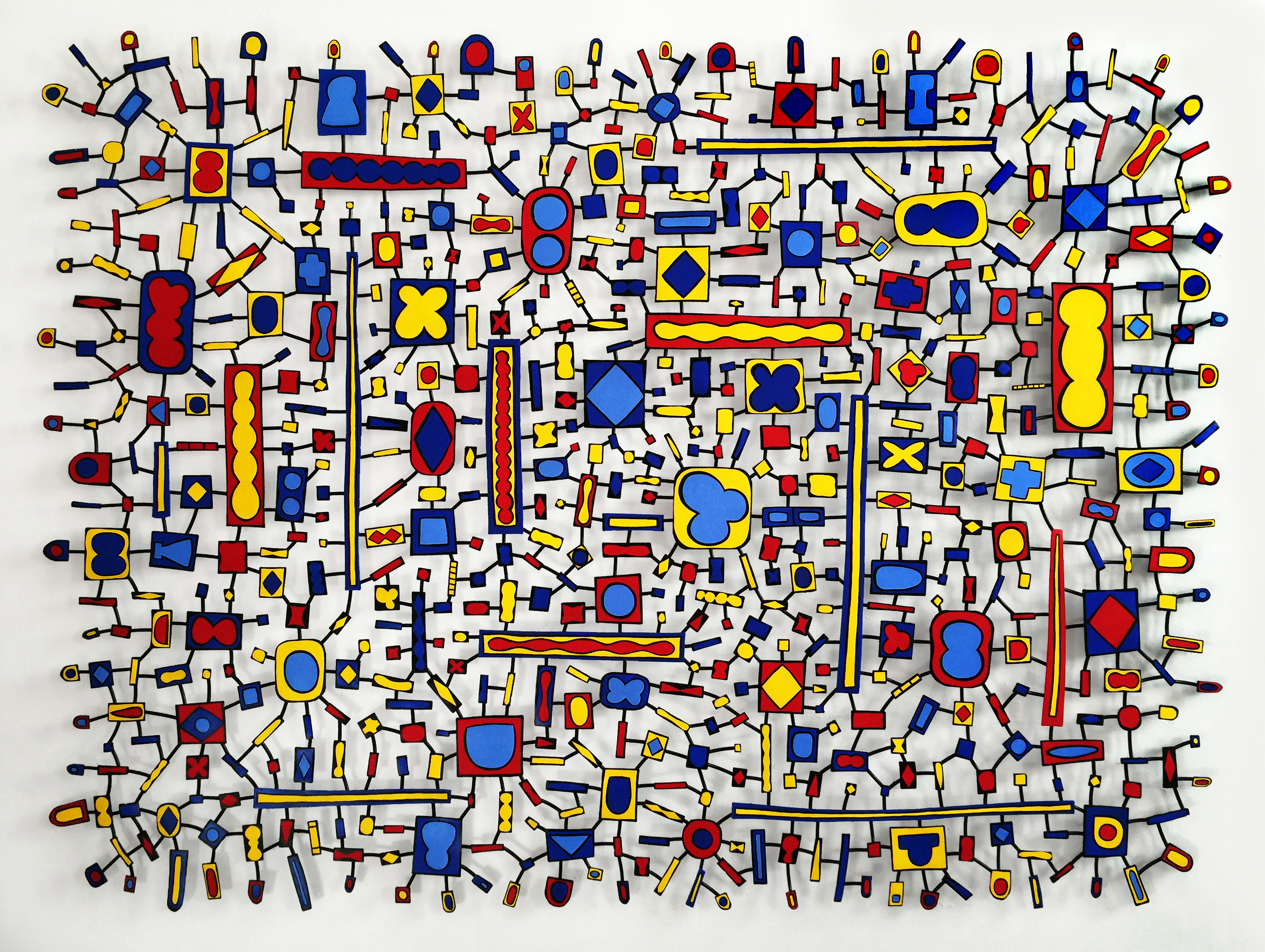
A few of these can be seen in his retrospective at the Montclair Art Museum, Tom Nussbaum: But Wait, There’s More! Curated by Gail Stavitsky, the museum’s chief curator, the exhibition, on view through January 4, includes more than 80 works spanning six decades and dazzles with color and form as the artist traverses the boundaries of figuration and abstraction. Even the exhibition title conjures childhood fun, almost like a line out of Dr. Seuss.
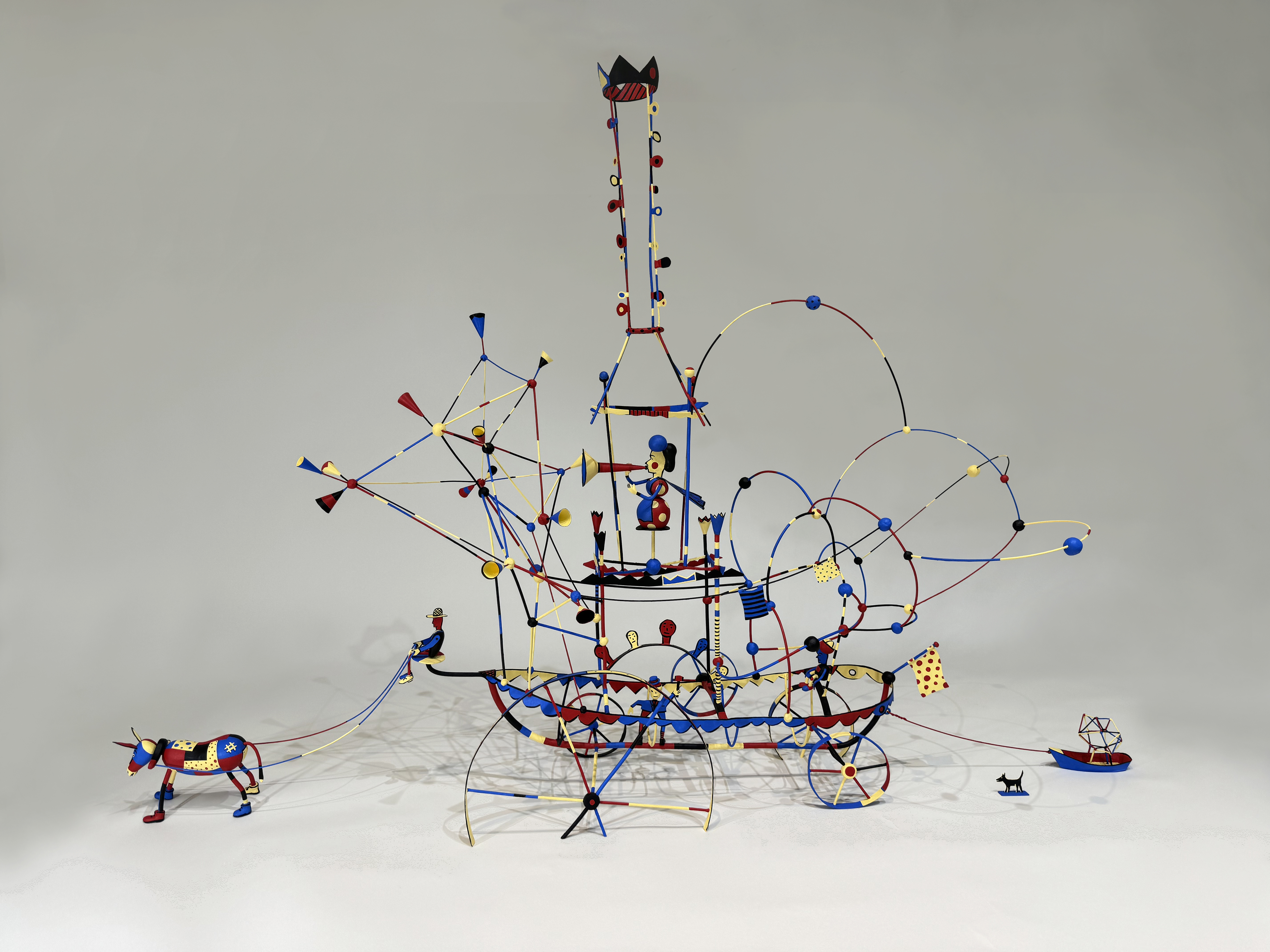
The title is shared by one of Nussbaum’s recent sculptures, which incorporates the artist driving a circus-like contraption, filled, in his words, with “art, life, and our fears and hopes for the future.”
Speaking of circuses, Nussbaum has been compared to sculptor Alexander Calder, whose miniature spectacle of circus animals and characters that he would enact for live audiences is considered his most formative work. Crafted from wire, wood, metal, cork, fabric, and string – materials Nussbaum also uses – Calder’s Circus is celebrating its 100th year.
Both Nussbaum and Calder were born in Philadelphia, and Nussbaum saw the traveling exhibition Calder’s Universe at the Walker Art Center in 1977. “Calder’s inventive creativity and variety of production would serve as important, ongoing models for Tom,” Stavitsky writes in the exhibition catalog.
Another key element in Nussbaum’s childhood was the 1955 Crockett Johnson book “Harold and the Purple Crayon,” in which a small child wielding the titular colored marker creates a world with a moon, an apple tree, a picnic and “all nine kinds of pie that Harold liked best.”
“It was an amazingly inspiring book, the story of an artist creating and inhabiting his world,” Nussbaum says from his studio in East Orange. “It’s what I do. Even the Crockett Johnson style of simple lines influenced on my work, drawing in a reductive way.”
Another early influence – especially for the style of line – was the artist Saul Steinberg, who described himself as a writer who draws and defined drawing as a way of reasoning on paper. Steinberg’s illustrations would arrive weekly in the New Yorker magazine, often on the cover.
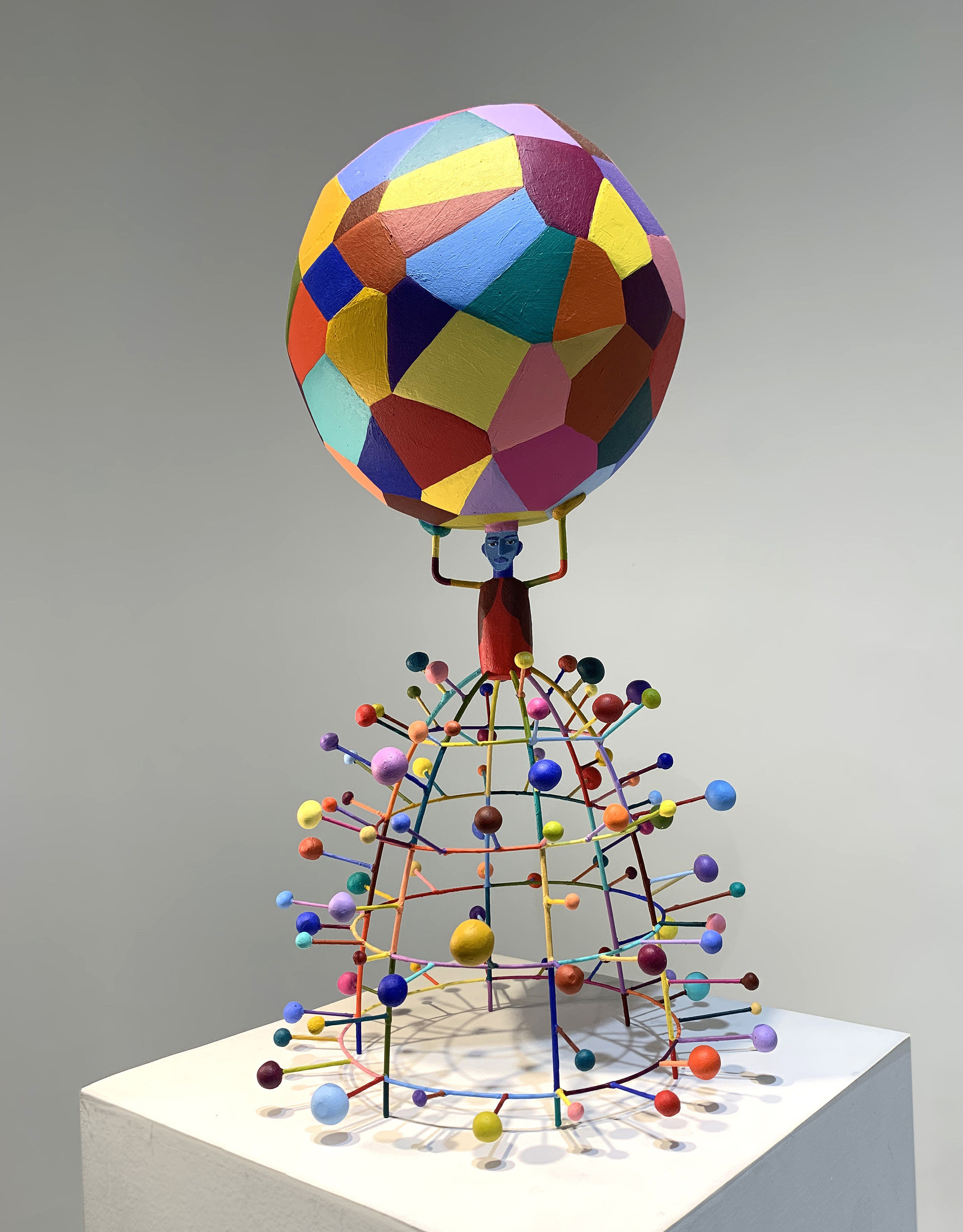
The exhibition traces how Nussbaum evolved from “somebody who just likes to make things” to an artist. And what better time to see all these colorful creations than the dark days of December, a perfect escape from the holiday madness.
Born in Philadelphia, Nussbaum and his family moved to Minneapolis, where his father was a professor at the University of Minnesota. Allen Nussbaum wrote and illustrated textbooks on such topics as semiconductors, and Stavitsky’s careful curation draws a line between these technical drawings and Nussbaum’s creativity. Allen Nussbaum was often compared to the Fred MacMurray character in the 1961 movie “The Absent-Minded Professor,” Stavitsky notes in the catalog.
Allen Nussbaum built a model train set with houses and mountains and tunnels, Nussbaum told WNYC’s “All of It” host Alison Stewart. “He built a harpsichord and a grandfather clock.”
“I grew up looking at his books, at their illustrations of molecular models,” he says. “The atoms were like Tinker Toys, with balls connected with sticks. My work refers to those in an abstract way, some intentional, some unconscious.”
Nussbaum had the good fortune to have teachers who understood the importance of breaking the rules as part of the creative process, as well as the chance to design his own high school curriculum, in which attending antiwar protests fulfilled the social studies requirement.
After studying ceramics at the University of Minnesota, Nussbaum worked as a production potter and a carpenter. He continued to pursue ceramic vessel forms as they evolved into linear basket-like structures.
He met the artist Rolla Herman, and they moved to New York City to work in the studios of Red Grooms and Mimi Gross.
Rolla came East first, in 1976, to work on Grooms’ “Ruckus Manhattan.” Nussbaum came soon after to work with Mimi Gross, who had just divorced Grooms. Herman and Nussbaum married in 1979, and Grooms invited the newlyweds to stay at his loft in Tribeca. Grooms and Gross “were very generous and supportive, and opened the New York art world for us,” says Nussbaum. “They were great role models in how to live an artistic life. Every part of their lives was filled with art and galleries and museums and exhibitions, and they welcomed us into that world.”
Gross, 85, still a good friend, attended Nussbaum’s opening at the Montclair.
After a day of working in her studio, Nussbaum would spend time in his own studio, building a body of artwork. Grooms helped to connect him to the Phyllis Kind Gallery, and Nussbaum launched as an independent artist.
Herman, a printmaker, went on to become an illustrator for the New York Times and New York Magazine. After the couple’s children were born, the family moved to Montclair.
Nussbaum’s work first appeared in the Montclair’s 1997 exhibition The Montclair Art Colony: Past and Present, and he had his first solo museum show at the museum in 2003, Home Sweet Home and Twenty Sculptures. In 2009, his sculpture “Listen” was installed on the museum’s grounds.
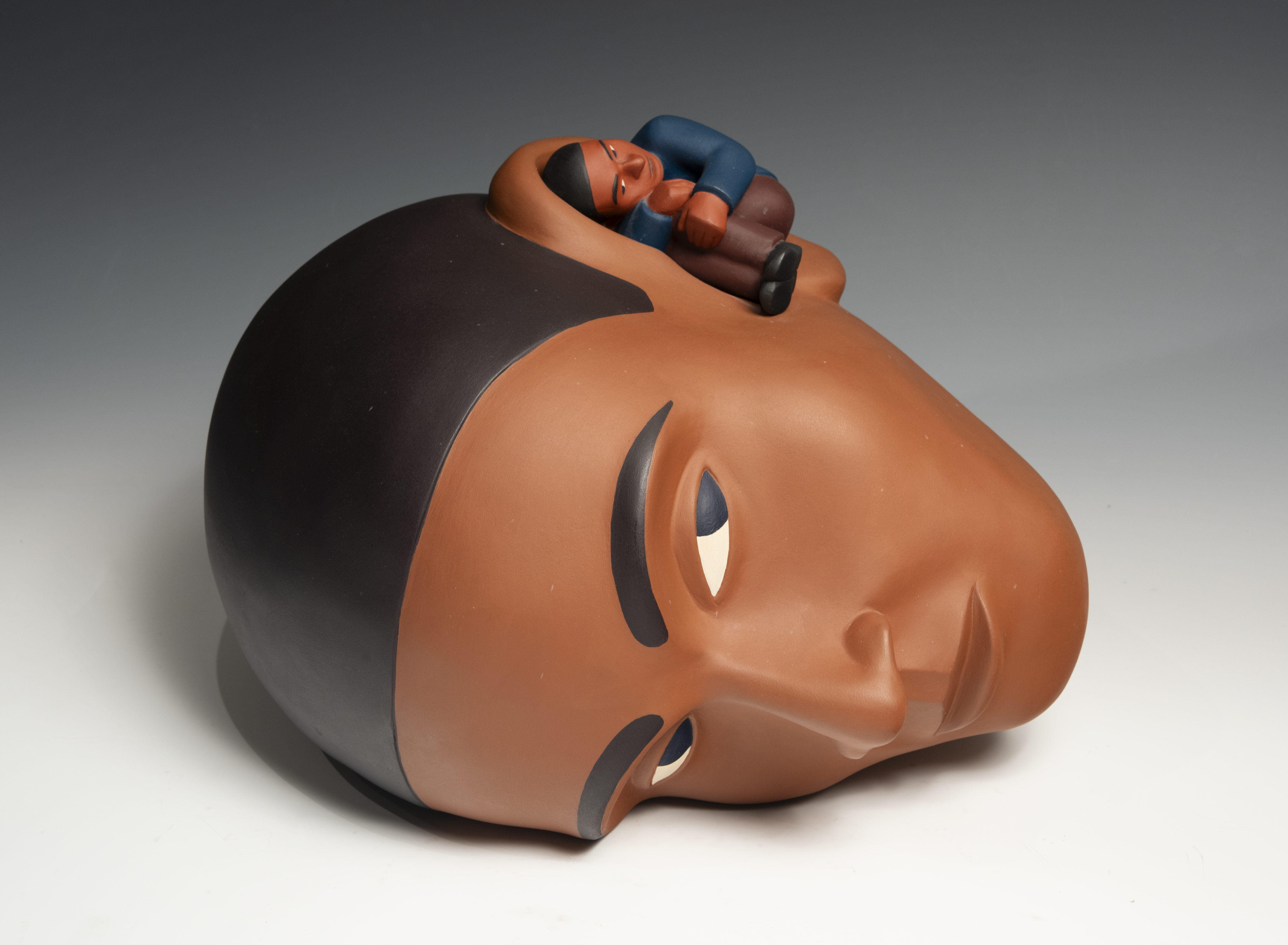
When his children were young (they are now 41 and 36), Nussbaum launched a couple of cottage industries, making night lights and other toys. He employed assistants to help in the making of those products, but for the most part, he prefers to work alone, hands-on, improvisationally.
At age 72, Nussbaum is still playing, although he works very hard for the playfulness we viewers get to experience. There’s behind-the-scenes work, especially for the more than 40 public artworks, represented by models in the exhibition. Some of the commissions have been for the Hasbro Toy Company, the MTA Metro North Railroad, New Jersey Transit, the Princeton Public Library and Albert E. Hinds Memorial Plaza in Princeton, Johns Hopkins Hospital, Charlotte Bloomberg Children's Center in Baltimore, and Memorial Sloan-Kettering Cancer Center in New York City.
Unlike his personal work, the commissions are all carefully thought out in advance and fabricated by a contractor. The process includes researching the subject, and conversations with community members, fabricators and engineers, project managers and art professionals. He says he enjoys every aspect.
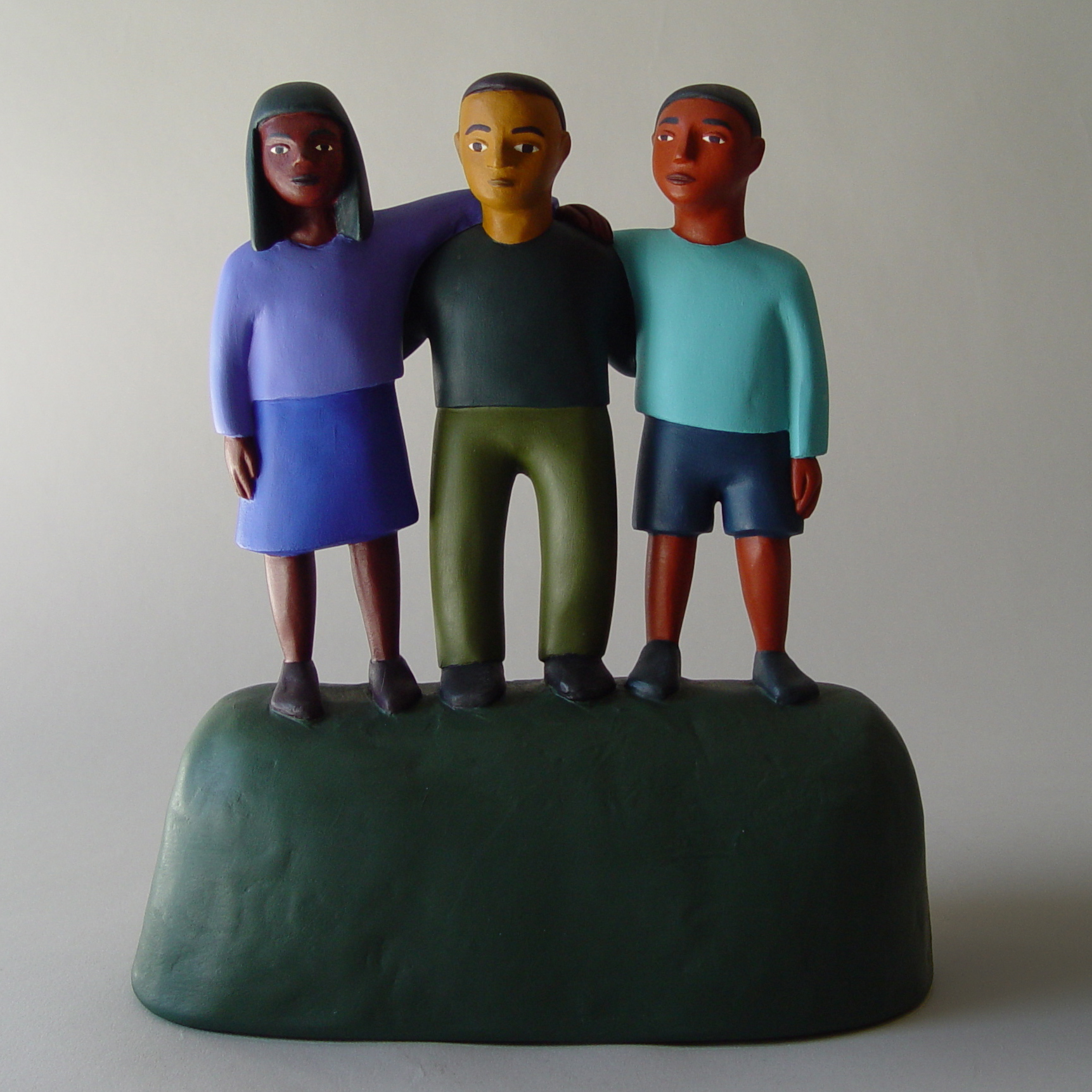
Nussbaum’s creations may be made from paper, clay, wood, epoxy, plaster, Scotch tape and paper clips – it doesn’t matter what the material is, as long as he can work with it and paint it, he says in a video made by the museum. “If that’s the shortest route to get where I want to go, then that’s what I use. You have to be comfortable with the material… and through that you begin to find your own voice.”
The three-time MacDowell Colony Fellow often doesn’t know what the piece is about until after it’s finished. “Every piece I do leads to new ideas; I figure out what the meaning is for me.” He encourages viewers to find their own meaning.
“My work is the result of a process of self-discovery, a mining of images that have personal and psychological meaning. These images usually first appear in drawings and then develop intuitively as I work, using a wide range of materials.”
He is not only inspired by the work of recognized artists but by the anonymous artists, makers, and builders of textiles, dolls, furniture, and utilitarian and sacred objects. In fact he has an extensive collection of folk art.
“Most of what I admire is simply made with the human desire to create,” says Nussbaum, who considers the influence of “folk” or “indigenous” artists equal to that of “fine” artists.
He still marvels at how his large mural “East Orange Boogie Woogie” – a colorful arrangement of semiconductor-type forms -- facing the Garden State Parkway (mile 143, East Orange, painted on the side of an abandoned building owned by the city) is seen by 10,000 people a day, albeit speeding by. “A lot of people don’t go to art museums, but they see public art daily. It’s very satisfying to have the audience.”