Exhibition Illuminates the Bloody Truth of Blood Donation





When you hold your hand up to a flashlight and see red, it’s not the blood in your hand that you’re seeing, but rather the one color of the spectrum – red – that passes through your hand. (The other colors are absorbed).
Walk into Jordan Eagles: Centrifuge at Art@Bainbridge, and you’ll see several figures that, at first, may appear thus illuminated. But, in fact, these figures are reflecting real blood. The photographs depict men in tender embrace, on whose skin blood has been projected using an overhead projector.
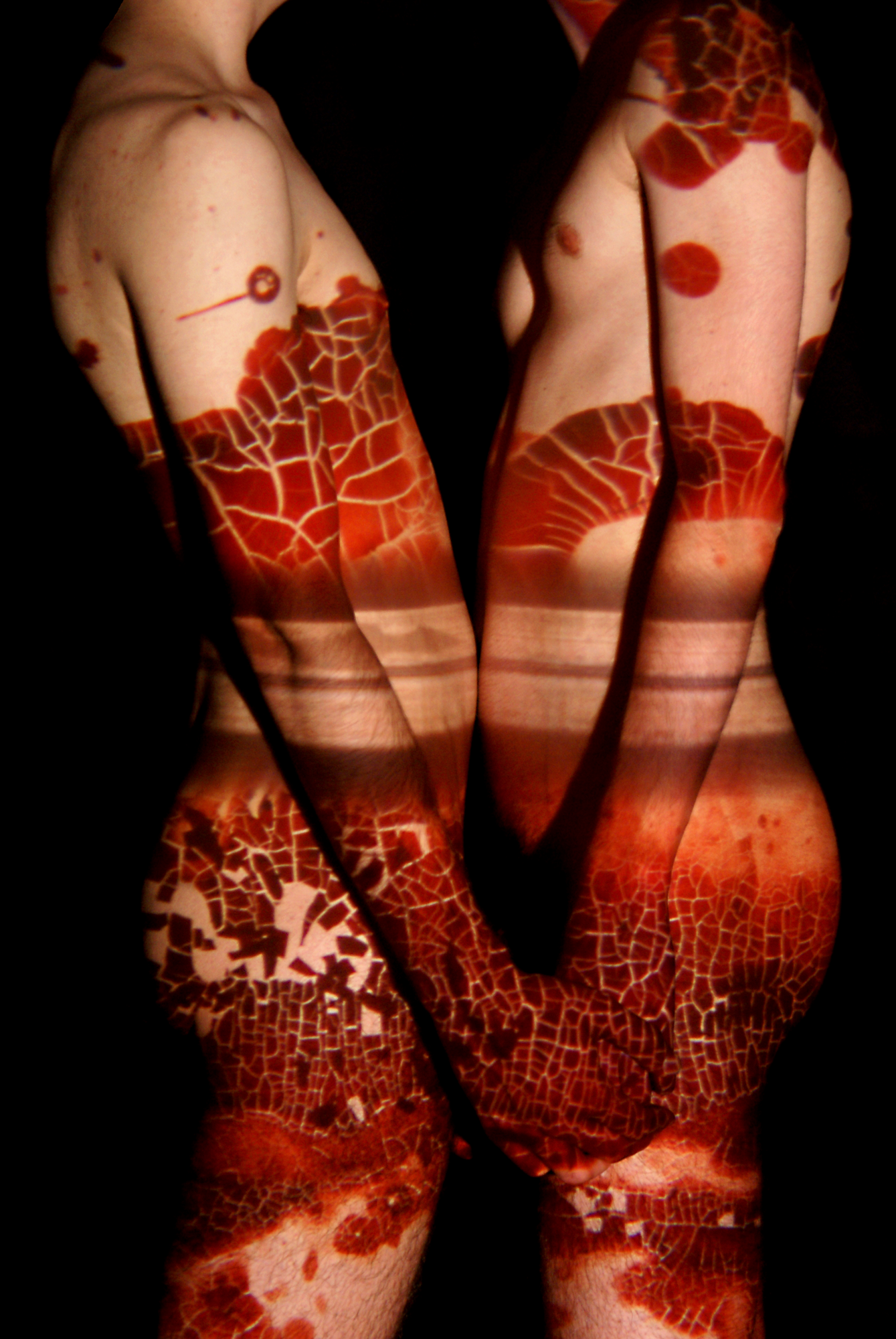
The New York-based Eagles has been working with blood as an artistic medium since the late 1990s. Born in 1977 and educated at New York University, Eagles says, “so often blood is viewed as something dangerous, murderous, or violent, when it’s a common fluid that we all share. It’s our common humanity.”
His process “combines chemistry, biology, and artist alchemy,” he says in a video. Eagles has developed preservation techniques, such as resin, to retain the colors, patterns, and textures.
During the run of the exhibition, on view through March 15, there was programming that included blood-red projections onto the Princeton University Art Museum and onto museum visitors. Some of the resulting images can be seen on a large screen slideshow at Art@Bainbridge.
“Blood – ordinarily hidden beneath the skin – is projected outward, transforming the human form into a living canvas of veins, lesions, and organic fractures,” says the exhibition catalog. “Featuring crackling patterns and cellular textures, the images oscillate between the beautiful and the brutal, evoking the visual language of both scientific imaging and sacred ritual.”
The artwork speaks to the legacy of HIV/AIDS, “recalling the stigmatized imagery of rashes and Kaposi’s sarcoma, as well as the medical gaze that rendered gay bodies suspect,” according to exhibition materials, and intends to “inspire dialogue about the effects of identity-based policies for blood donation and thus about wider questions of identity and personhood.”
Many consider blood gory, and so there is a note at the gallery entrance warning visitors of what to expect (indeed, some have opted out). Others are drawn in by the beauty of the blood-red imagery.

Eagles’s work includes painting, sculpture, installation, photography, and video. He uses both animal blood (sourced from slaughterhouses) and human blood, contributed by those he calls collaborators. His volunteer donors are from the LGBTQ+ community, and they all share the desire to advocate for fair blood donation polices and stigma reduction. Before 2023, when FDA guidelines for blood donation were revised to eliminate questions about a prospective donor’s gender and sexual orientation, blood donations from men who have sex with men were banned.
Princeton University Art Museum first acquired a work by Eagles 10 years ago, and museum Director James Steward has been wanting to do an exhibition on him ever since, according to Centrifuge Curator Chris Newth, senior associate director for collections and exhibitions at the Princeton University Art Museum.
Even though the museum opened its brand new world-class building in late 2025, it will continue to operate Art@Bainbridge as a gallery to show emerging to mid-career and more experimental artists, says Newth. With exhibitions like Centrifuge, “an artist can bring awareness to issues that are timely and compelling in a way that speaks to the community.”
For Centrifuge, “We selected artwork that is intriguing, that will get a reaction, as it becomes clear that blood is spectacle,” Newth continues.
The second room of the exhibition incorporates comic books from the 1980s and 90s. They are encased in resin, with layers of blood and test tubes, hospital booties, collection bags, paint brushes, and more. “I hadn’t realized that so many comics took on AIDS as subject matter,” says Newth.
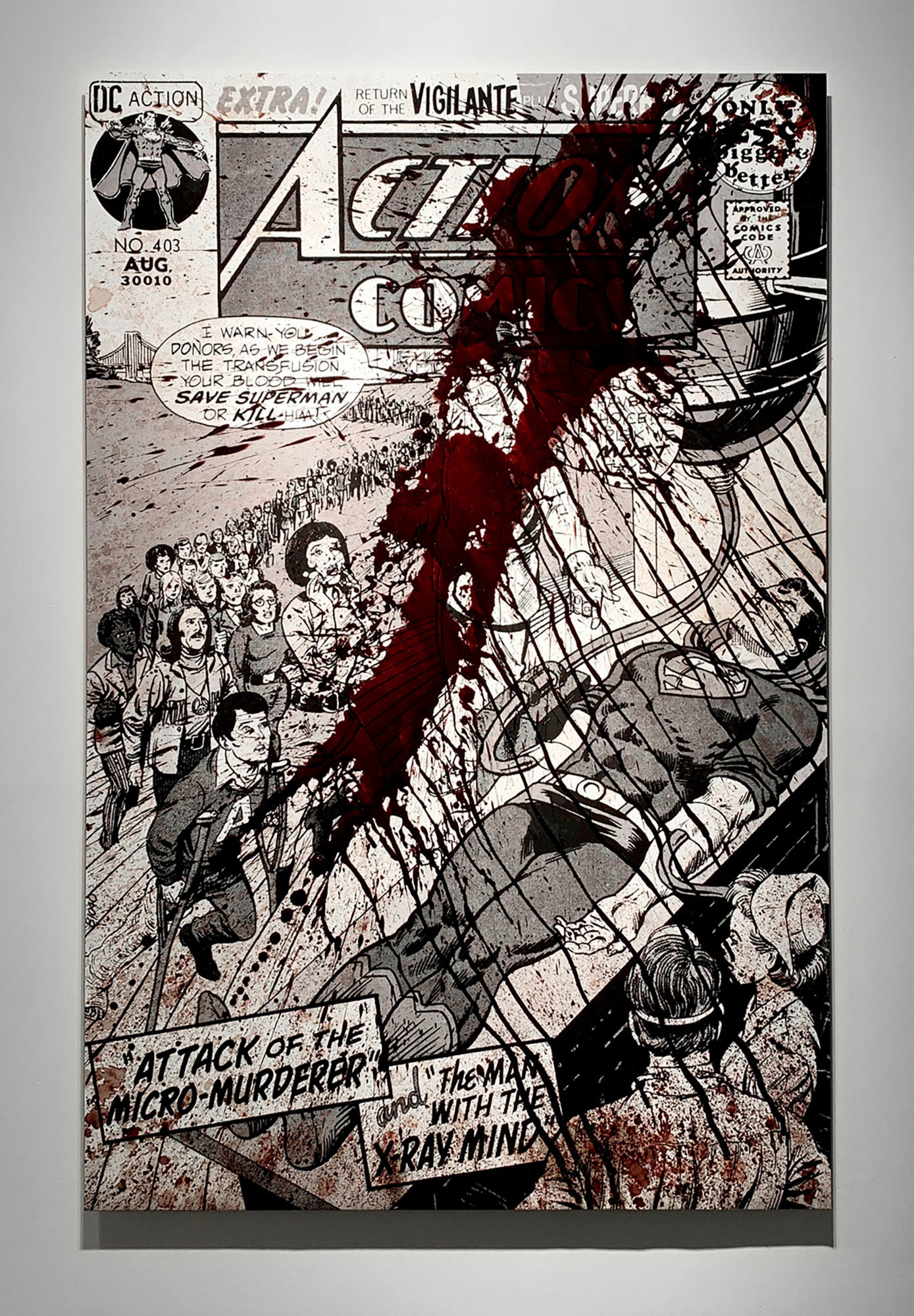
One of the comics, inspired by Action Comics' “Attack of the Micro-Murder” (1971) in which Superman is infected by a futuristic super virus and lies lifeless on a gurney, shows people lining up to donate blood to save Superman. Eagles’ version, “American Carnage 6/14,” was done in response to the Parkland school shooting and the Pulse nightclub massacre that targeted LGBTQ+. It made Eagles think about how he wanted to be a part of the solution. Here he is showing how policies have regressed: while gay men could have donated blood to save Superman in 1971, by 2018, FDA policies barred LGBTQ+ individuals from donating to blood banks.
And it isn’t just LGBTQ+ people who are discriminated against in the world of blood donation. During World War II, according to the catalog, Black people were barred from donating blood, despite the need. Eagles expresses his frustration at the lost opportunity to collect blood for life-saving purposes.
In yet another room, Eagles uses AI tools to show gay men donating blood, and how it can reflect and reinforce societal biases about blood donation from certain populations. “The (gay blood donors) are shown stereotypically happy with rainbow colors,” says Newth. “It shows how our policies are created by peoples’ thoughts, not science.”
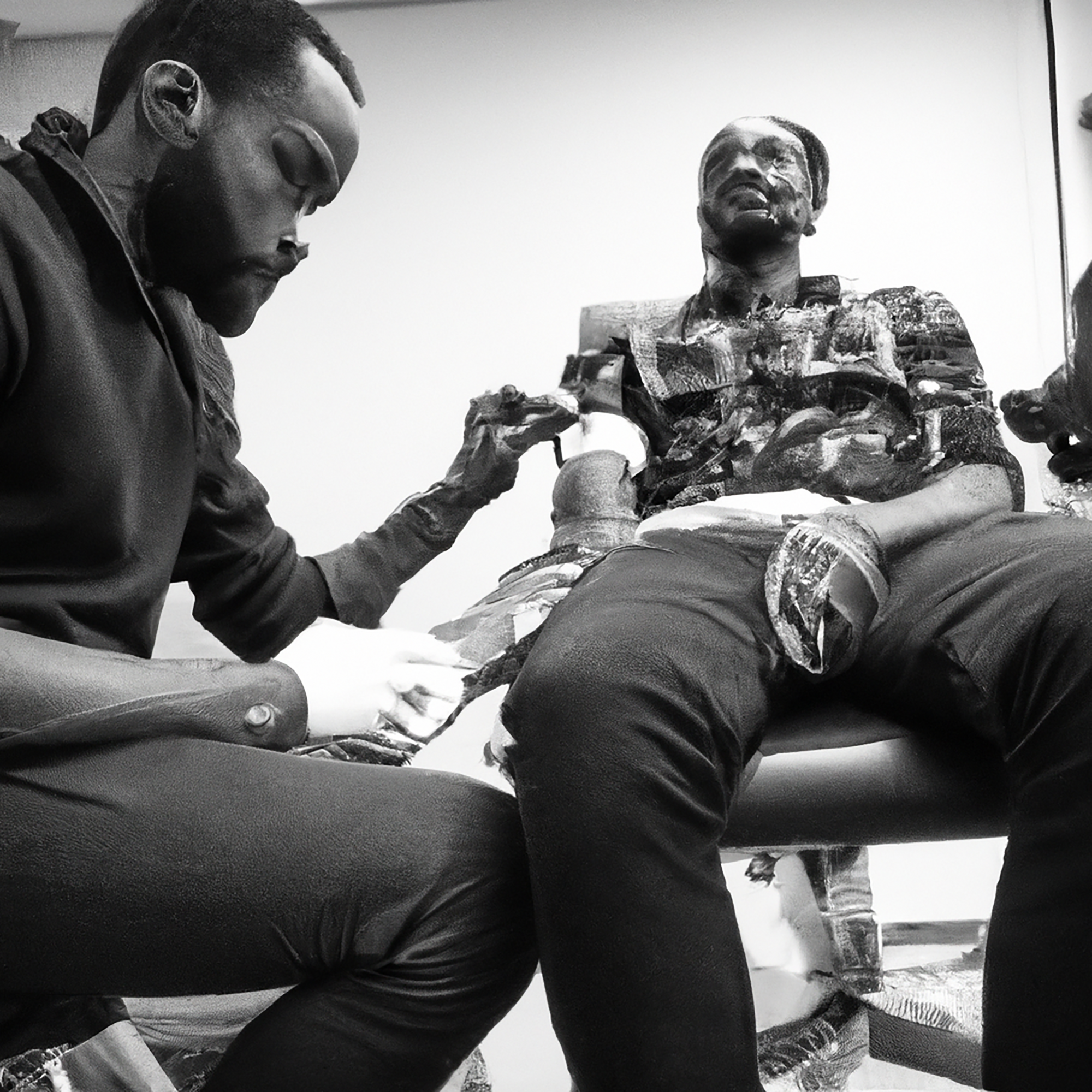
When ChatGPT and DALL-E were given prompts and asked to visualize terms such as “gay men,” “LGBTQ+,” or “non-binary people donating blood,” they generated imagery with distorted bodies and exaggerated facial expressions; these became metaphors for how these individuals were reduced to caricatures and misrepresented.
In the final room, Eagles has incorporated the cover of a Christie’s auction house catalog that depicts a painting attributed to Leonardo da Vinci of Jesus Christ as Savior of the World. It sold for $450.3 million, the highest price ever paid for a painting. This made Eagles question, how do we assign value?
Reflecting on Christ as savior of the world with his blood, Eagles encapsulates the catalog cover with blood collection tubes, butterfly needles, and residual blood from an HIV+ activist. The 12 tubes refer to both the 12 apostles and the 12-month celibacy requirement for gay and bisexual blood donors.
“Eagles positions Jesus as history’s most consequential blood donor,” says the catalog, “shedding his blood for the salvation of all.”
Some of Eagles’ collaborators (blood donors) may no longer be alive, says Newth, “but a part of them is in these works.”


