Artists’ Long Tradition of Activism Marches on in Arts Annual 2025 at Rowan University Art Gallery & Museum





As we view cleverly designed signs at contemporary marches and protests, we are reminded of the many roles artists play as activists. In both overt and subtle ways, artists have a long history of trying to affect social and political change. Ever since ukiyo-e woodblock printing became available in 17th and 18th-century Japan, printmakers have been able to communicate to the masses.
Francisco Goya used his artistic platform to critique the social and political issues of the 19th century, addressing themes of corruption, injustice, and the horrors of war, often using satirical and grotesque imagery to convey his messages. In France, Honoré Daumier was known for his social and political commentary, particularly through his caricatures and lithographs.
In the decades after the 1910–20 Mexican revolution, artists such as Diego Rivera, David Alfaro Siqueiros, José Clemente Orozco, and Rufino Tamayo made prints that furthered social and political reforms.
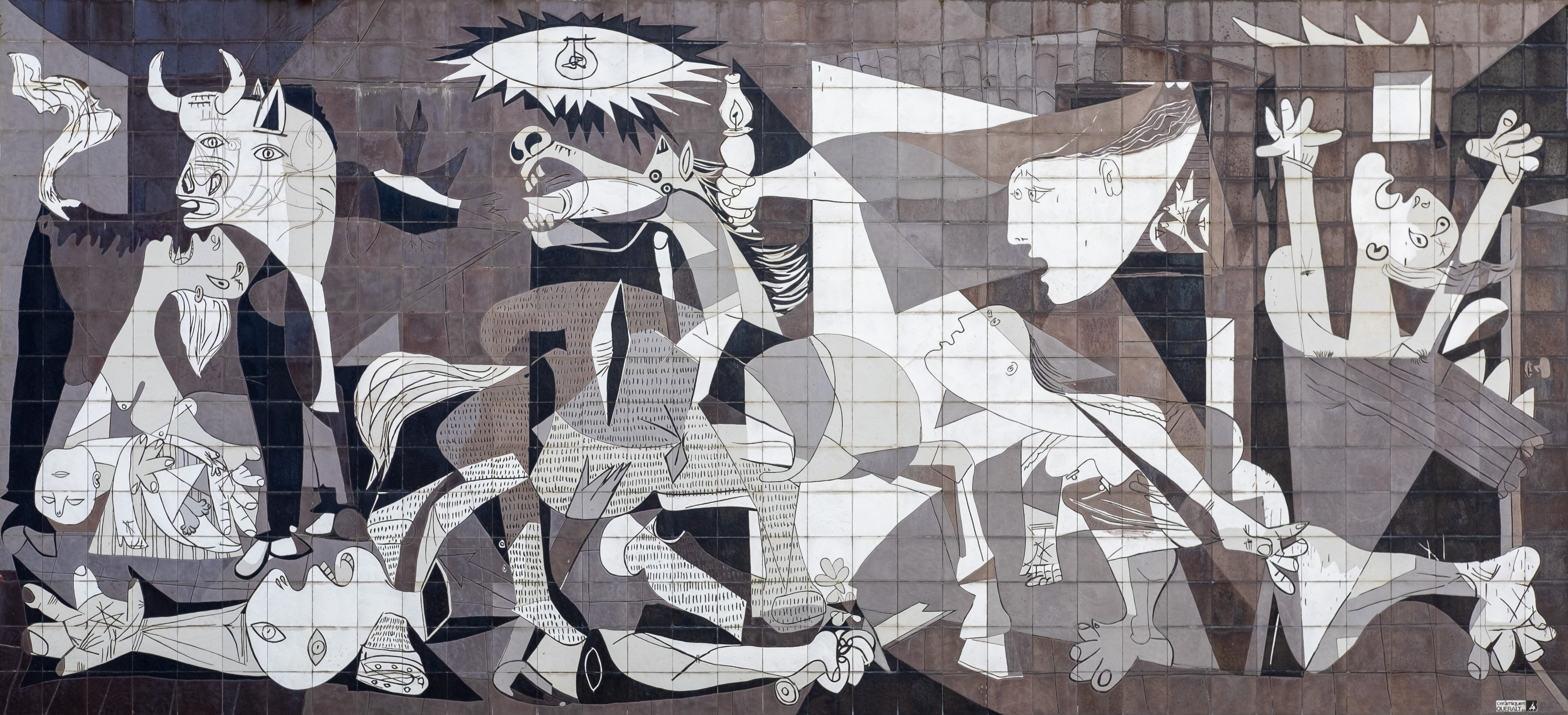
One of the most well-known examples of art as social activism is Picasso's “Guernica,” painted as an immediate reaction to the Nazi's bombing the eponymous Basque town during the Spanish Civil War. The enormous painting, heralded for its reportage style, shows the tragedies of war and the suffering it inflicts, particularly on innocent civilians.
The Whitney Biennial often sparks artists and activists to use it as a platform to address social and political issues. Recent Biennials have seen protests, boycotts, and artwork directly engaging with topics like police brutality, gentrification, and the museum's funding sources.
The Guerrilla Girls, the anonymous group of feminist artists, often creates public disruption to combat sexism and racism within the art world. In a less confrontational way, Kerry James Marshall’s art deeply engages social and political issues related to race and representation in the art world. Ai Weiwei, Faith Ringgold, Kehinde Wiley, Jenny Holzer — so many others carry on the tradition of creating work that awakens us to the tragedies, inequities, and strife of the day. Their work is often intended to raise awareness, spark dialogue, and inspire change. Art can communicate complex issues in ways that words sometimes cannot, reaching audiences on an emotional and visceral level and cultivating empathy.
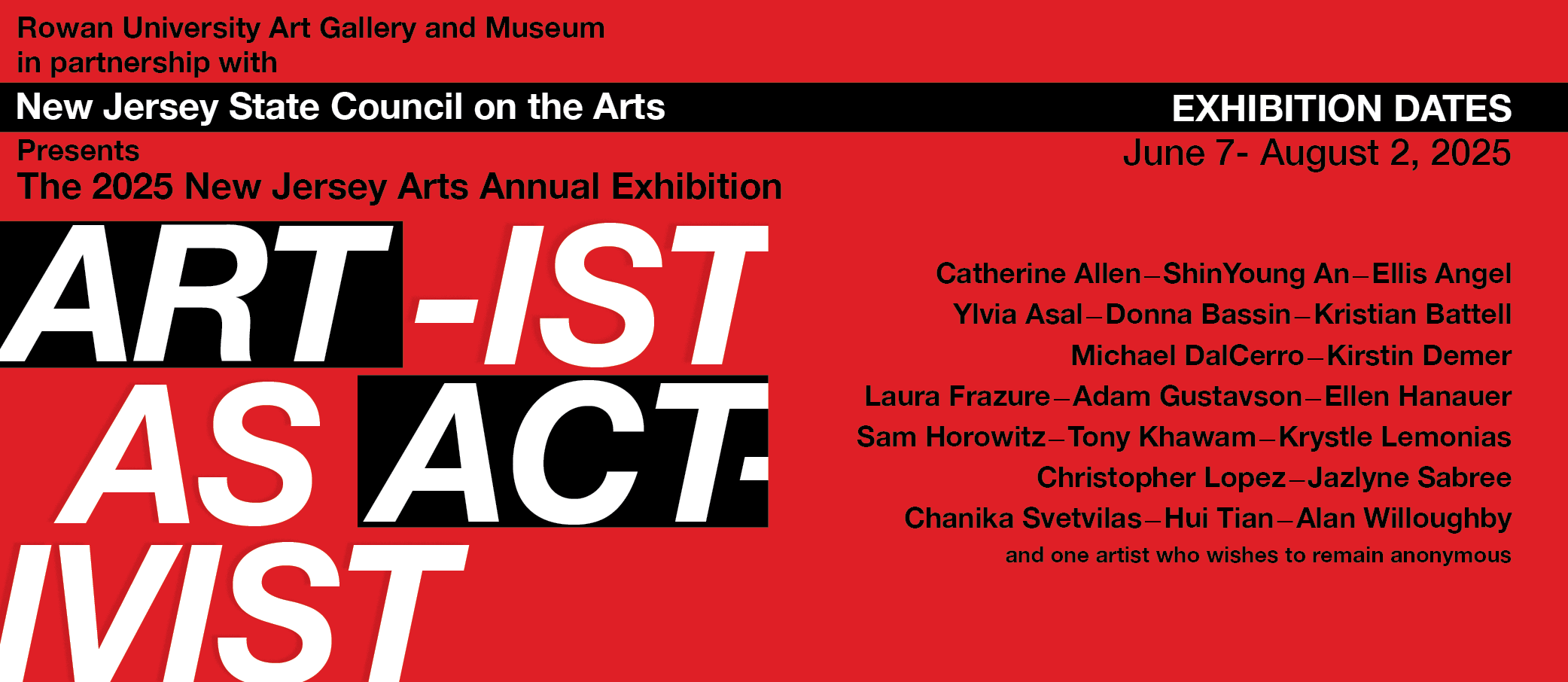
This year, for its Arts Annual, the New Jersey State Council on the Arts has selected the theme “Artist as Activist.” The 20 artists (chosen by guest jurors Brittany Webb and Dejay Duckett from 300 who responded to an open call) use their creative practices to challenge societal norms, raise awareness, and inspire audiences to engage critically with the world around them, according to the press release. Topics addressed include human rights, environmental stewardship, racial equity, health and well-being, and political engagement.
On view at Rowan University Art Gallery & Museum in Glassboro through August 2, hope, fear, courage, patriotism, satire, justice, and dreams are expressed through media ranging from digital illustration, etching, book arts, and mixed media to ceramics and sculpture.
Using charcoal and pages torn from the Diagnostic and Statistical Manual of Mental Disorders, Chanika Svetvilas – she describes herself as “an interdisciplinary artist grounded in her lived experience as a Thai American woman with a mental health difference”- leaves her mark on paper that scrolls 18 feet across the gallery.
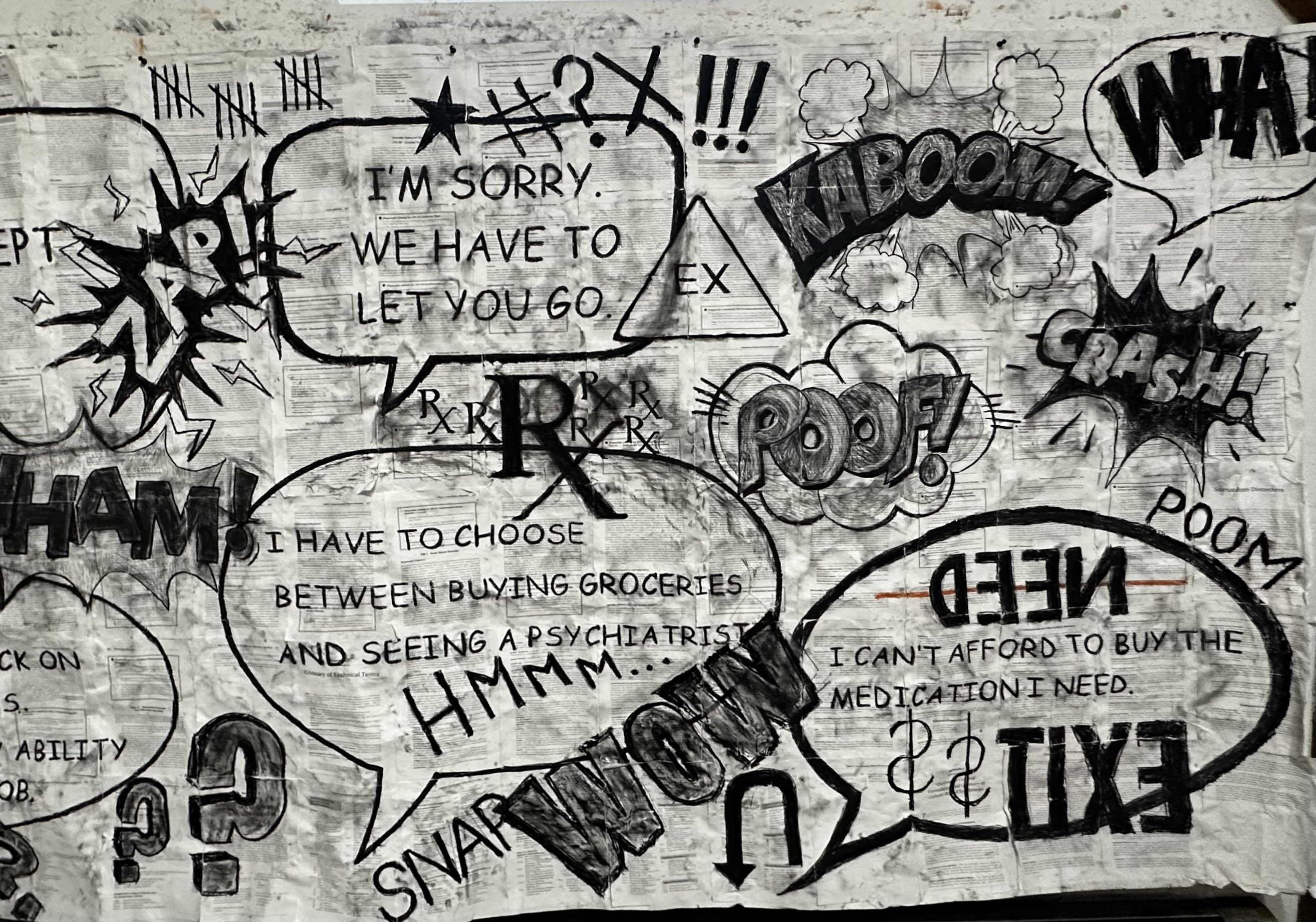
With cartoon-like words and fonts (“POOF!” “CRASH!” “KABOOM!!!”), the symbol for prescription (Rx), cross hatchings that seem to mark off days in isolation, and thought bubbles, she writes: “I have to choose between buying groceries and seeing a psychiatrist,” and “I can’t afford to buy the medication I need.”
“The waitlist to see a psychiatrist near me is six months to two years.”
Some words are written backwards, and indeed, it looks like a plea from a person in captivity. She has described being hospitalized for mental illness as being in lockdown.
“This work developed based on (a) lived experience of bipolar diagnosis. It is an extension of continued interest to utilize narrative as a way to share experiences, disrupt stereotypes, reflect on contemporary issues, and create safe spaces through my art.”
Her oeuvre – part of which has been exhibited at the Denver International Airport, the Brooklyn Public Library, and the Asian Arts Initiative – typically includes prescription bottles, medical texts, and objects from her personal archive, and reflects her resistance to the American mental health care system. She has made large sculptural forms using plastic pill bottles, some of which she makes into costumes, and videotapes herself wearing them.
Svetvilas uses humor to get her message across. In another scrolling work (not on view here), she describes the figures as “My bipolar neurons play with mischief!”
When she was 24, prior to her bipolar diagnosis, Svetvilas was hospitalized for a severe manic episode. She found the hospitalization far more traumatizing than the episode itself. Once, when hospitalized for taking an overdose of sleeping pills, she woke up spewing up the charcoal she’d been given, and has since chosen it as a medium for her drawing. “Charcoal is used to absorb chemicals after a stomach is pumped,” Svetvilas notes in her writeup.
Remember “In the Night Kitchen”? Maurice Sendak’s magical tale of Mickey, who wakes in the night and tumbles downstairs into the Night Kitchen, where three doughy bakers are in need of milk for the morning cake. They mistake Mickey for the milk, stir him into the batter, and carry him towards the oven. But Mickey jumps free (“I’m not the milk and the milk’s not me”), builds a plane out of dough and flies to the Milky Way, returning with a giant bottle of milk. The cake can be baked, and Mickey returns safely to his bed.
What about this 1971 Caldecott winner cannot be loved?
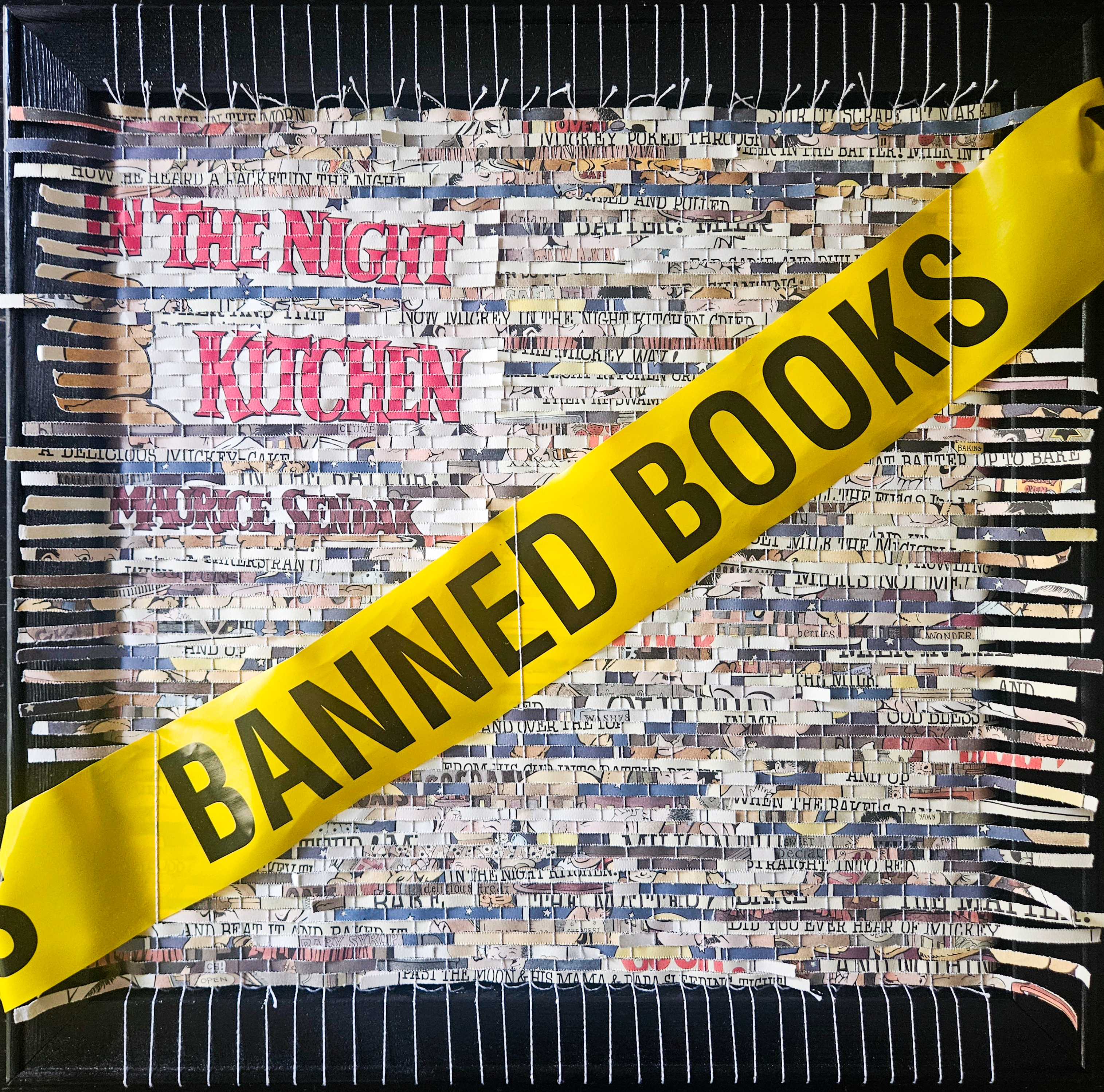
And yet it has fallen to some banned books lists because, in his adventure into the night kitchen, Mickey – a very small, cherubic child – loses his jammies. He is naked. (Ironically, that the little boy nearly got baked in the cake never set off any alarms.)
Artist Ellis Angel has something to say about that, starting with a quote from Eric Asimov: “Any book worth banning is a book worth reading.”
Angel created a series in response to the rise in organized censorship, “orchestrated by a vocal minority that has escalated dramatically.”
Angel’s mixed-media paper weavings convey a commitment to social justice. Working with shredded Constitution pages to deconstructed protest posters, Ellis’s intricate weavings are acts of resistance and reflection, made to spark conversations about governance, identity, and human rights. Whether weaving U.S. currency into critiques of corruption or transforming torn pages of banned books into powerful symbols of intellectual freedom, Angel presents art as a force for change.
Each work begins by shredding the physical book and reweaving it, transforming the silencing of a text into something visible, undeniable, and new. By intertwining traditional weaving techniques with contemporary themes, like gun violence, women's rights, and immigration, Angel creates pieces that not only tell a story but also serve as a call to action.
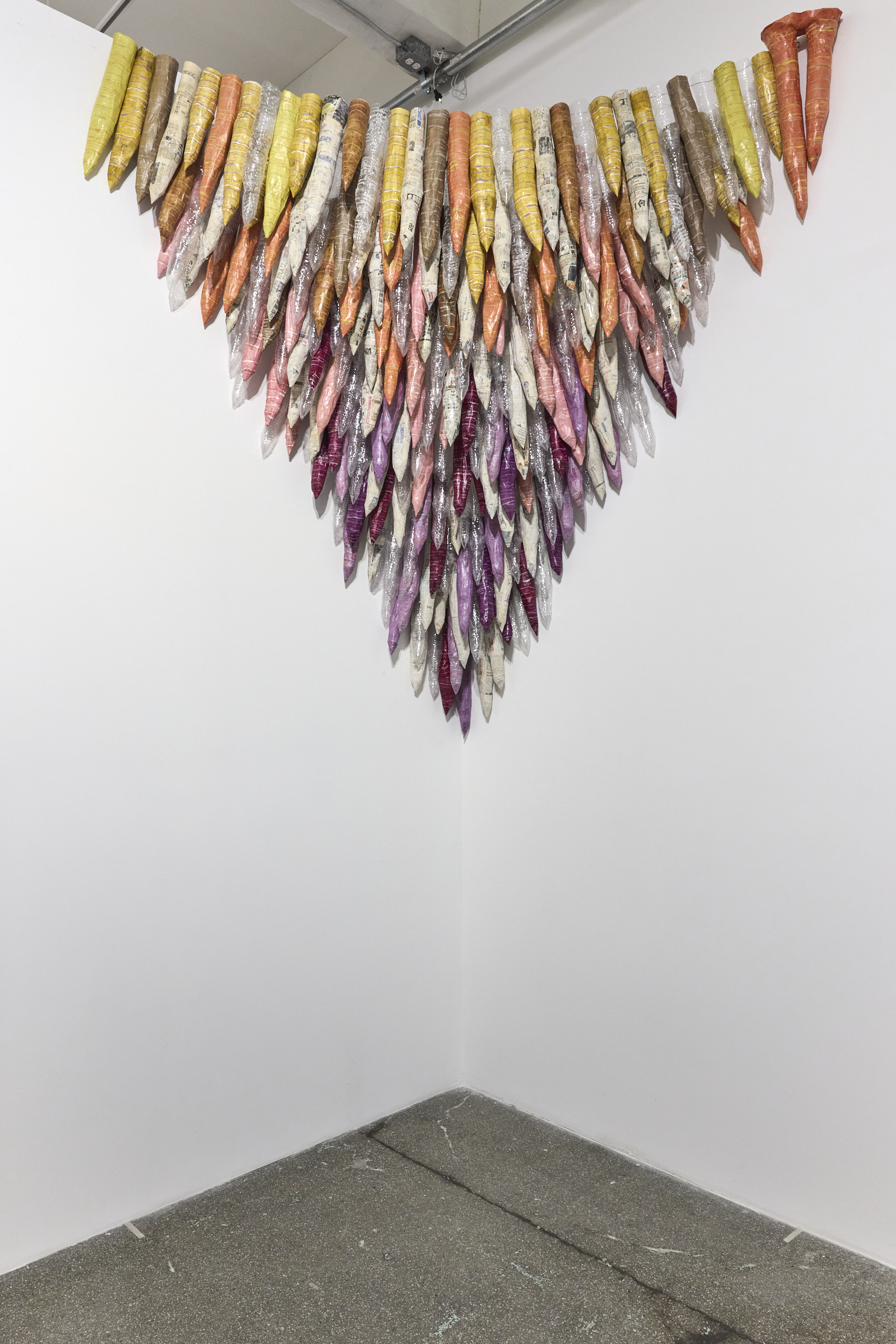
A lot of us feel the call to action to rescue our besieged planet, in dire straits from climate change, habitat loss, and the proliferation of plastics that kills wildlife and winds up in our own bodies. When artist Kristian Battell was stuck inside during the pandemic and her garbage was not getting picked up, she began incorporating it into her artwork, creating sculpture from plastic and other waste. Her “Anthropocene Cavern” is made from plastic, wheat paste, and silkscreen.
“These works focus on climate change by upcycling the materials that surround me in everyday life,” says Battell. “They portray a vision of future landscapes formed by the pressure of the buildup of waste and repercussions of a materialistic society. ‘Anthropocene Cavern’ is a site-specific work that depicts stalactites forming a cave made out of plastic and other recycling. The water bottles for the original form of this piece were collected from one family over the course of one month. It has since grown and changed forms, taking on a new shape in each location.”
When it was exhibited at Mana Contemporary in Jersey City, Mana posted to Instagram: “Is there a more representative symbol of our age than the plastic water bottle? It seems impossible to walk through a day without seeing Poland Spring and Aquafina bottles sitting on desktops, stashed in purses and backpacks, or empty and crushed, littering curbsides and overflowing sidewalk trash cans… It takes thousands of years for a stalactite to form on the ceiling of a cave, accreting mineral deposits drip by unhurried drip; in just a few decades we have accreted more empty water bottles on this planet than all the stalactite in the world, a hundredfold. Battell’s sculptural phalanx of plastic comes to symbolize our collective, throwaway culture in the Anthropocene age.”
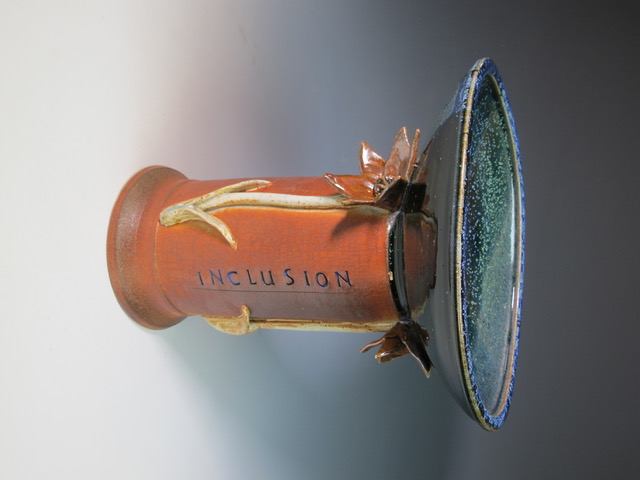
Alan Willoughby, adjunct professor at Rowan and, from 1991-2016, executive director of Perkins Center for the Arts, has created in clay “DEI (Diversity/Equity/Inclusion) with amaryllis, a flower that symbolizes strength, beauty, pride, resilience and determination.”
“Several years ago, I began my Empowerment Series combining my love of creating handmade pottery with a commitment to equal rights, social justice and environmental sustainability,” Willoughby writes. “Working within the relative isolation of my studio, I could no longer escape the violence, the inequality, the injustices taking place in the world around me. This led me to press words into the moist clay and carve them out of the clay, words that have the power to envision a better world.”
One artist, who chose to remain anonymous because of the political environment and retaliations, writes: “My love of this country is as strong as my belief that democracy is the best political system ever invented. In the end, goodness and virtue will prevail over the desire to suppress.” Thank you, Anonymous!
“Activists, like artists, come from all walks of life,” writes Lieutenant Governor Tahesha Way in the exhibition catalog. “And activism takes many forms. Voting is activism. Public service is activism. Making your community a better place to live is activism… Visitors will encounter a collection of work by New Jersey artists that will inspire them to see things anew and, hopefully, carry that inspiration with them back out into the world.”


