Borders Don’t Stop the Flow of Ideas, Traditions, and Culture at Grounds For Sculpture





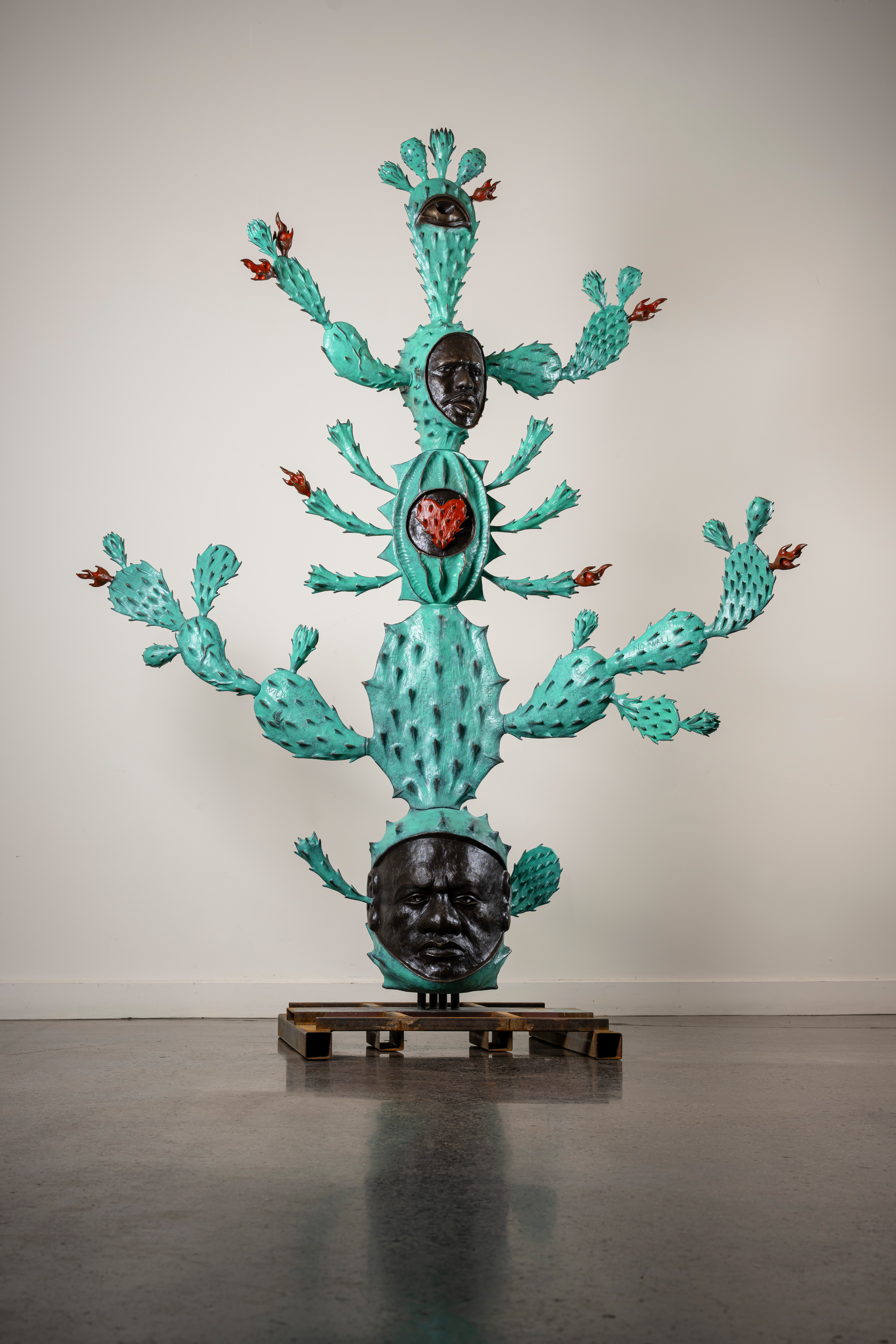
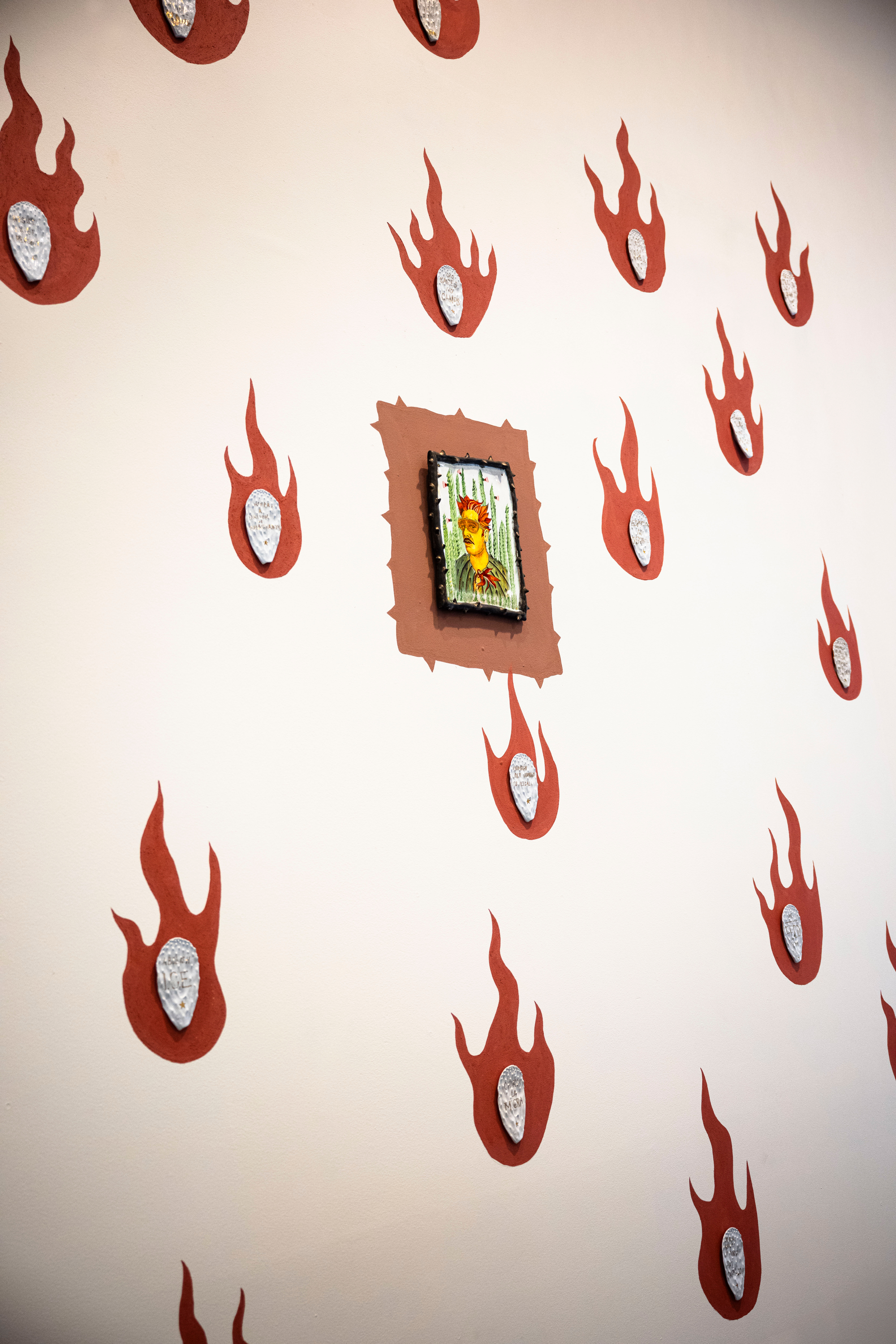
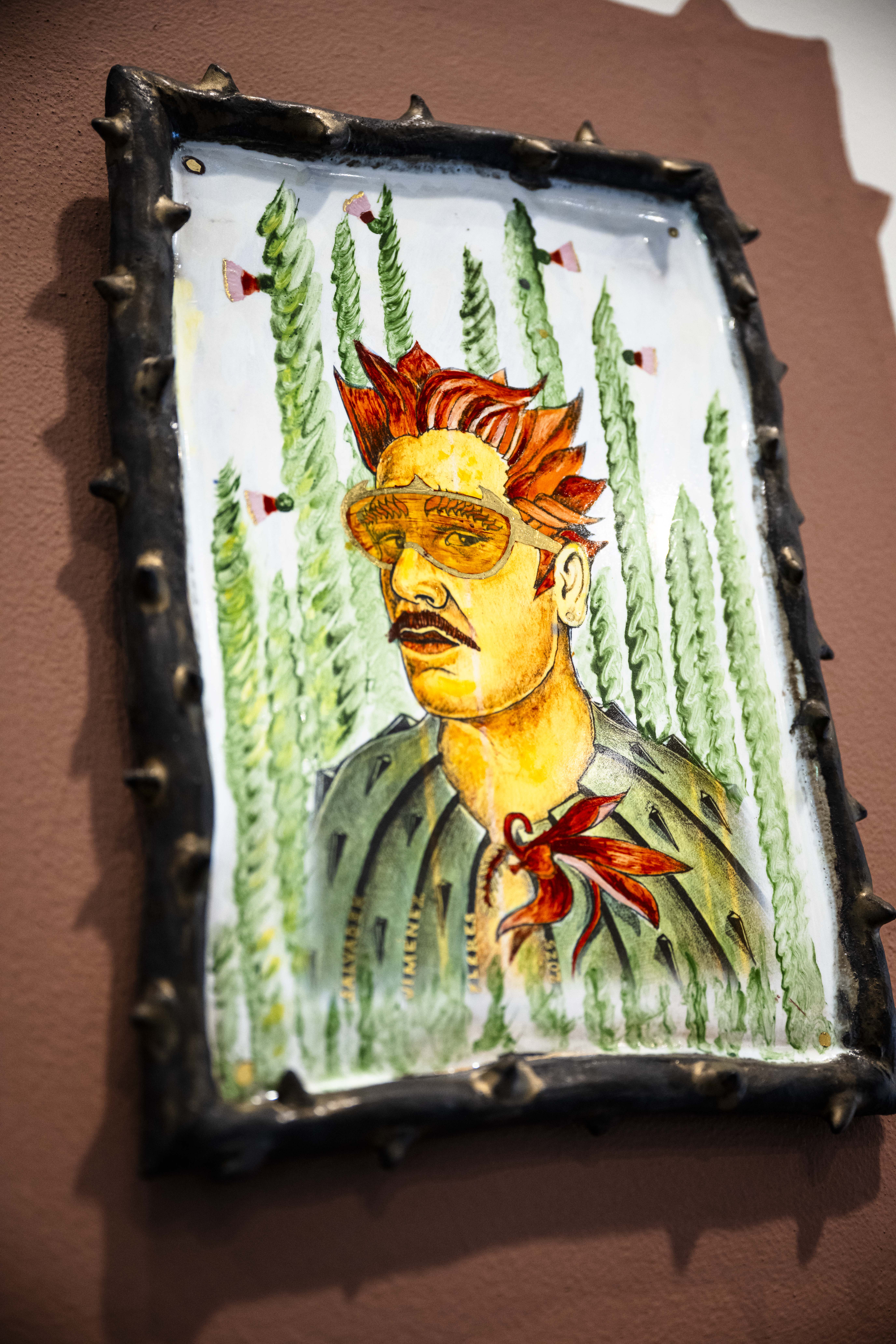
Despite the grayness of the season, prickly pear cacti are sprouting at Grounds For Sculpture. There are cacti on the walls and cacti surprising visitors strolling the gardens – one bronze, with faces peering out, and another growing in a terra cotta pot. (Yes, prickly pears grow well in New Jersey.)
With its yellow flower and brilliant red fruit, the prickly pear has been a source of food, medicine, and tools for indigenous Americans for millennia. A symbol of Mexico, it is featured on its flag. Cochineal insects that live on the prickly pear, when dried and crushed, become a luxuriant red dye. Mayan and Aztec people used cochineal in their opulently colored textiles. When Spanish conquistadors discovered its radiance, they brought cochineal to Europe, establishing a monopoly on this commodity that symbolized wealth and power, coloring the garments of European elites, Catholic cardinals, and British uniforms.
While viewing Salvador Jiménez-Flores: Raíces & Resistencias (Roots and Resistance), on view at Grounds For Sculpture through August 1, 2027, I find myself thinking about such exploitations of Mexico’s riches and how, under Manifest Destiny, land that was once Mexico was usurped by the U.S., taking our country “from sea to shining sea.” Now, Mexicans are no longer welcome in the land that was once theirs.
I am thinking about Latino agricultural workers who die, on average, at two-thirds the age of other Americans because of exposure to agrochemicals, among other harsh conditions, and that these dedicated workers are not even welcome here anymore.
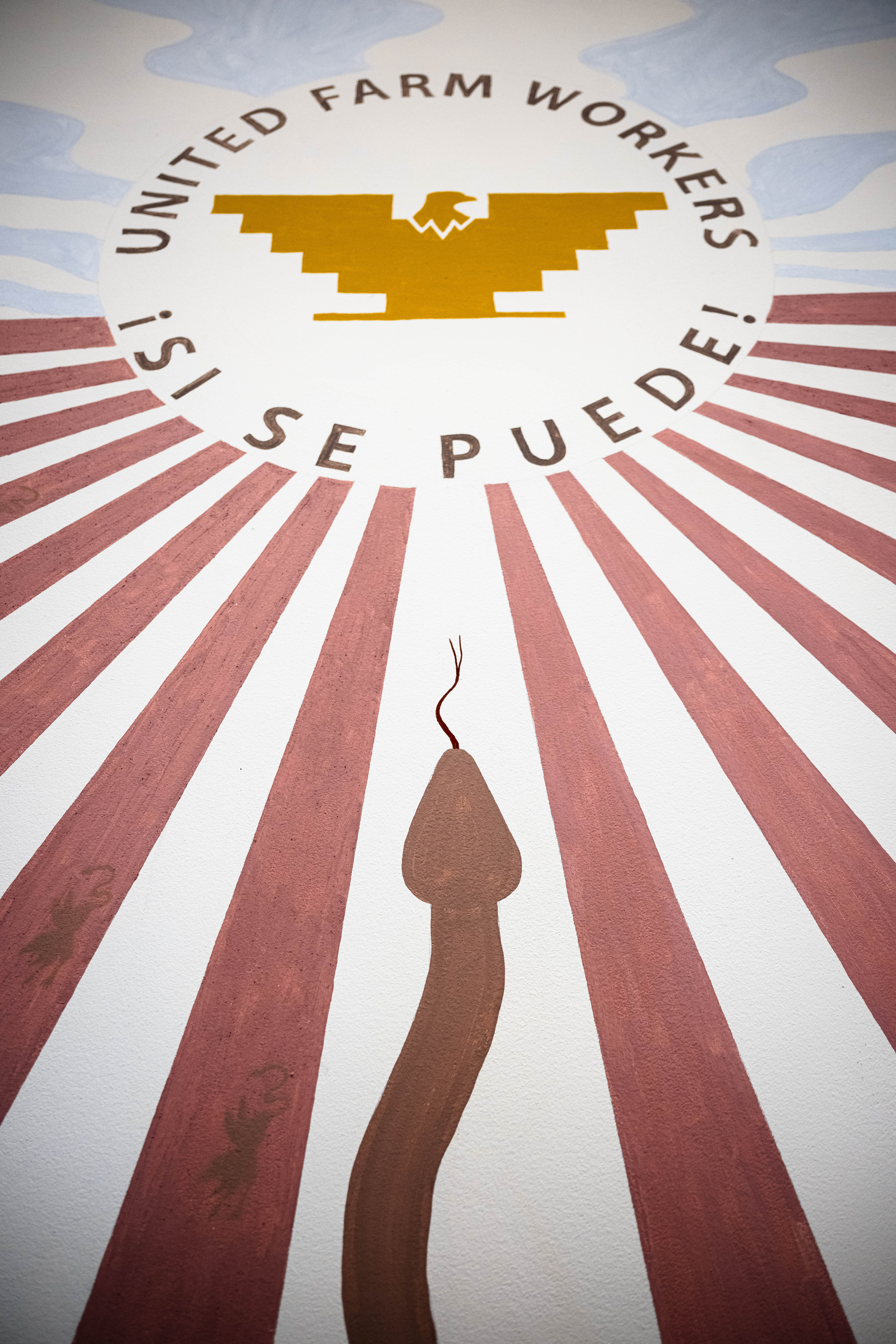
On the 80-foot wall in the East Gallery, Jiménez-Flores has created Memoria, Tierra, Trabajo: A Glimpse of the Semi-Quincentennial, a mural painted with earthen pigments. As the United States gears up to celebrate its 250th anniversary, the mural serves as a reminder of the colonization, migration, and unfair labor practices that make up its history.
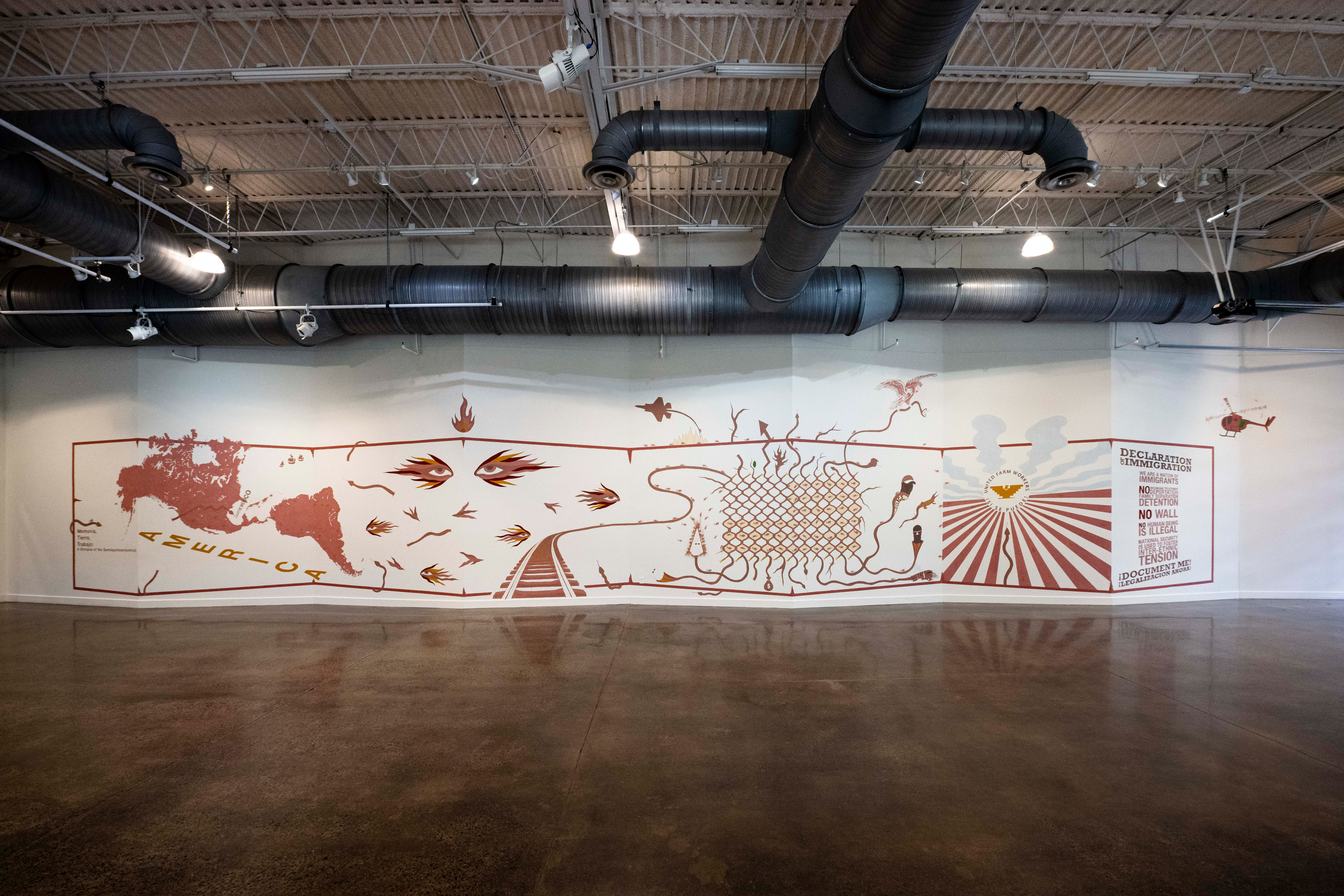
I see men – ICE officers? – whose faces are clothed in black masks; surveillance helicopters, KKK masks entwined with a chain-link fence; a white cloth sack with dollar signs and a truck emblazoned with NAFTA – it’s a Kafka-esque reminder of what’s going on in the world outside the idyllic sculpture park.
In New Jersey, “close to a quarter of our residents were born outside the U.S., so we knew that a series of artworks that explored the hybrid migrant experience and layered history of immigration would be relevant, timely, and important as our country is set to celebrate our anniversary,” says Grounds For Sculpture Executive Director Gary Garrido Schneider, who curated the exhibition. "During a time when art and artists are being silenced, GFS continues to be artist-led and responsive to the world we live in.
“We believe in artists’ ability to help us better understand our past and present, and imagine a future through the unique perspectives they bring to the world,” Schneider continues, feeling encouraged by the response to the exhibition – visitors of all backgrounds are sharing their migration stories. “People recognize a piece of themselves in Salvador’s artwork and others feel less alone in their thoughts.”
Born in Jalisco, México, in 1985, Jiménez-Flores, a professor for the School of the Art Institute of Chicago, explores his experiences as a bicultural immigrant in his interdisciplinary artwork.
Jiménez-Flores’ family has migrated between México and the United States over three generations through programs that invited migrant labor to build the railroads or to work in agriculture. His great-grandfather first arrived in the Midwest in the 1900s for railroad construction. Traqueros, or track workers, were Mexican and Mexican-American laborers who built the railroad from the mid to late 19th century until the early to mid-20th century.
His family did not accompany him during those grueling years. “Like many men of his generation, he migrated temporarily, working for long stretches before returning home to Mexico,” says Jiménez-Flores. “His journey set a pattern that echoed through generations: labor migration as both survival and sacrifice.”
Decades later, his father would migrate through the Bracero Program, which invited Mexican nationals to come to the U.S. from the 1940s to 1960s for temporary agricultural work. “He experienced firsthand the hardships and dignity of migrant labor — the long hours, the separation from family, and the hope that his work would create more stable opportunities for the next generation.”
Jiménez-Flores’ father eventually made his way back to Chicago in search of job stability, but later, in the 1980s, the family returned to Mexico, where Salvador was born. At 15, Salvador rejoined his family members, who had once again found themselves in Chicago.
“The traquero and Bracero programs didn’t necessarily allow our family to stay — they were structured as temporary, extractive labor systems. But through those experiences, my family carved out its own sense of belonging between two countries. Their resilience and movement across borders shaped not only my life story but also the questions that continue to guide my art: labor, migration, and a sense of belonging.”
Arriving in Chicago was both a cultural shock and a moment of awakening. “Everything was new — the rhythm of the city, the language, even the light. There were challenges, of course: language barriers, cultural differences, and the feeling of being between worlds. But there was also energy and curiosity.”
It was in a high school darkroom photography class where he came alive as an artist. “Developing those first black-and-white images felt like magic — the way light could become memory on paper.” He realized that “art was another kind of language, one that didn’t require translation. Through images, I could communicate across barriers, find connection, and tell stories that words often failed to hold. That moment was the beginning of everything for me. Art became a way to bridge worlds —to make sense of displacement, belonging, and the constant movement that has defined my family’s life.”
Jiménez-Flores began working with clay when a friend organized a community gathering in which artists made ceramic bowls for a pozolada, or a celebration involving eating pozole, inspired by the “Empty Bowls” project. “That day became a turning point for me,” he says. The other local artists “gave me a crash course in ceramics — I hand-built a bowl, coiled a vessel, slab-built a plate, and even attempted to throw on the wheel, which ended in total failure.
“But something profound happened through that failure. The next day, I called my graduate advisor and switched my elective to ceramics. Everything changed. Clay became a language I didn’t know I was fluent in.”
Clay’s origins in the earth related to his family history of working the land.
“I come from a lineage of farmers in Jalisco, México — people whose relationship with the land was one of respect, reciprocity, and survival,” says Jiménez-Flores. “My summers were spent alongside my father in the milpa (a traditional Mesoamerican intercropping system where corn, beans, and squash are grown together, a practice also known as the "Three Sisters"), tending to maize, sorghum, cardamom, and agave. Those experiences taught me that the earth is not a resource to be extracted, but a living being that responds to care and intention.
“When I work with clay,” Jiménez-Flores says, “I continue that dialogue with the land. Clay, like soil, holds memory — it carries the stories of generations, the trace of rain, roots, and the hands that have shaped it before me. Both farming and art-making require patience, humility, and faith in transformation. In the fields, we plant seeds and wait for the harvest. In the studio, I mold earth and wait for the kiln’s fire to reveal what it has become.”
For the two large murals – created during a two-week residency in July — painting the white walls with red earthenware slip was an act of claiming space, a way of “transforming sterile white walls into something that reflected my identity, my community, and the histories embedded in the material itself. By covering the space in clay, I was literally browning the walls to create an environment that could hold the complexity of my work.”
Jiménez-Flores’s process is inspired by pre-Columbian murals made with earth pigments, “murals that served as both documentation and storytelling, recording the lives, rituals, and struggles of their makers. When I use clay slip, I’m continuing that tradition: marking space with the same earth that has witnessed our histories.
“The smell of wet clay — tierra mojada — instantly takes me back to my childhood in México, to the first rains hitting dry soil.”
Jiménez-Flores appreciates the ephemeral nature of the medium. “Once the show ends, the clay is washed away, leaving only memory behind. That ephemerality feels honest — it speaks to migration, transformation, and the resilience of rebuilding and reclaiming space again and again.”
Back to those prickly pears, which appear frequently in his work. Also known as nopales, “they’re such a generous plant — nourishing, healing, and deeply symbolic. I personally love them grilled with some olive oil and salt. I also love the tuna, the prickly pear fruit, with chile, salt, and lime. For me, nopales are more than food — they’re a reminder of resilience and adaptation. Just like in my artwork, they embody survival in harsh conditions, finding ways to thrive and nourish despite the obstacles.”


